Top Visa on Arrival Countries for Indian Passport Holders (List, Fees & Documents)
This article is part of our complete International Tourist Visa Guide for Indians - read that first if you're not yet sure whether your destination needs a visa at all.
Visa on Arrival Countries for Indian Passport Holders
A visa on arrival (VOA) means you do not apply before you fly. You land, join a separate counter, submit a form, a photograph and your supporting documents, pay a fee (almost always in cash), and receive your visa stamp on the spot. This is different from visa-free entry (no visa document at all, no fee) and an eVisa (approved online before you travel - required for boarding). Indian passport holders currently have visa-on-arrival access to a meaningful number of countries across Asia, Africa, the Middle East and the Caribbean/Pacific, though several Middle Eastern VOAs are conditional - they only work if you already hold a valid US, UK or Schengen visa. The exact list shifts through the year, so treat this as a reviewed guide, not a permanent record.
What "Visa on Arrival" Actually Means
"Visa on arrival" is one of the most misused phrases in Indian travel planning. Travellers often use it loosely to mean "no paperwork needed" - which causes real confusion at check-in counters, because it is genuinely a different category from visa-free travel.
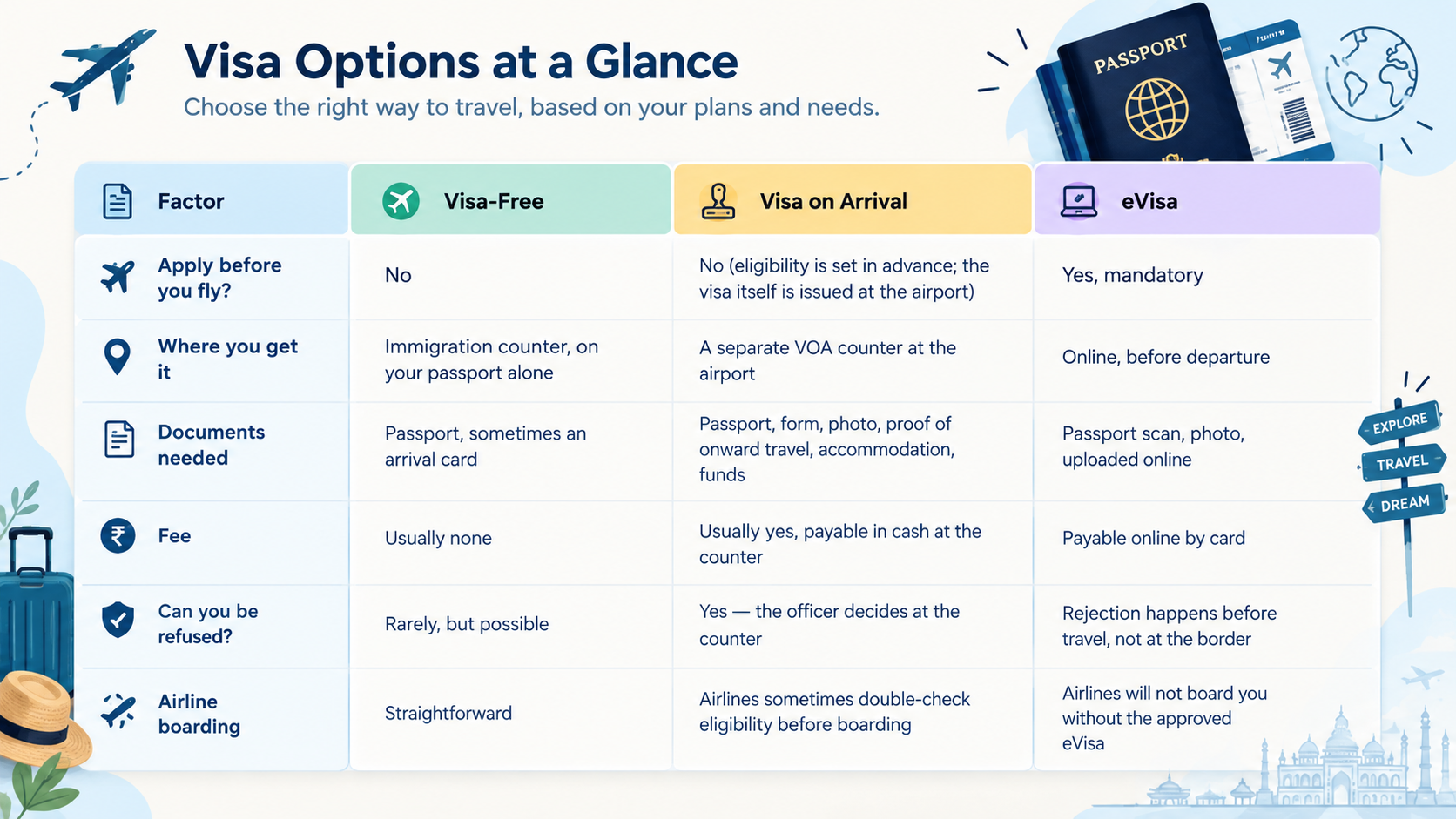
The distinction that matters most: a VOA country still requires you to obtain a visa. The only difference from an embassy visa is where and when you get it - at the airport, after you land, rather than in India beforehand.
Visa on Arrival Countries for Indians - Full List
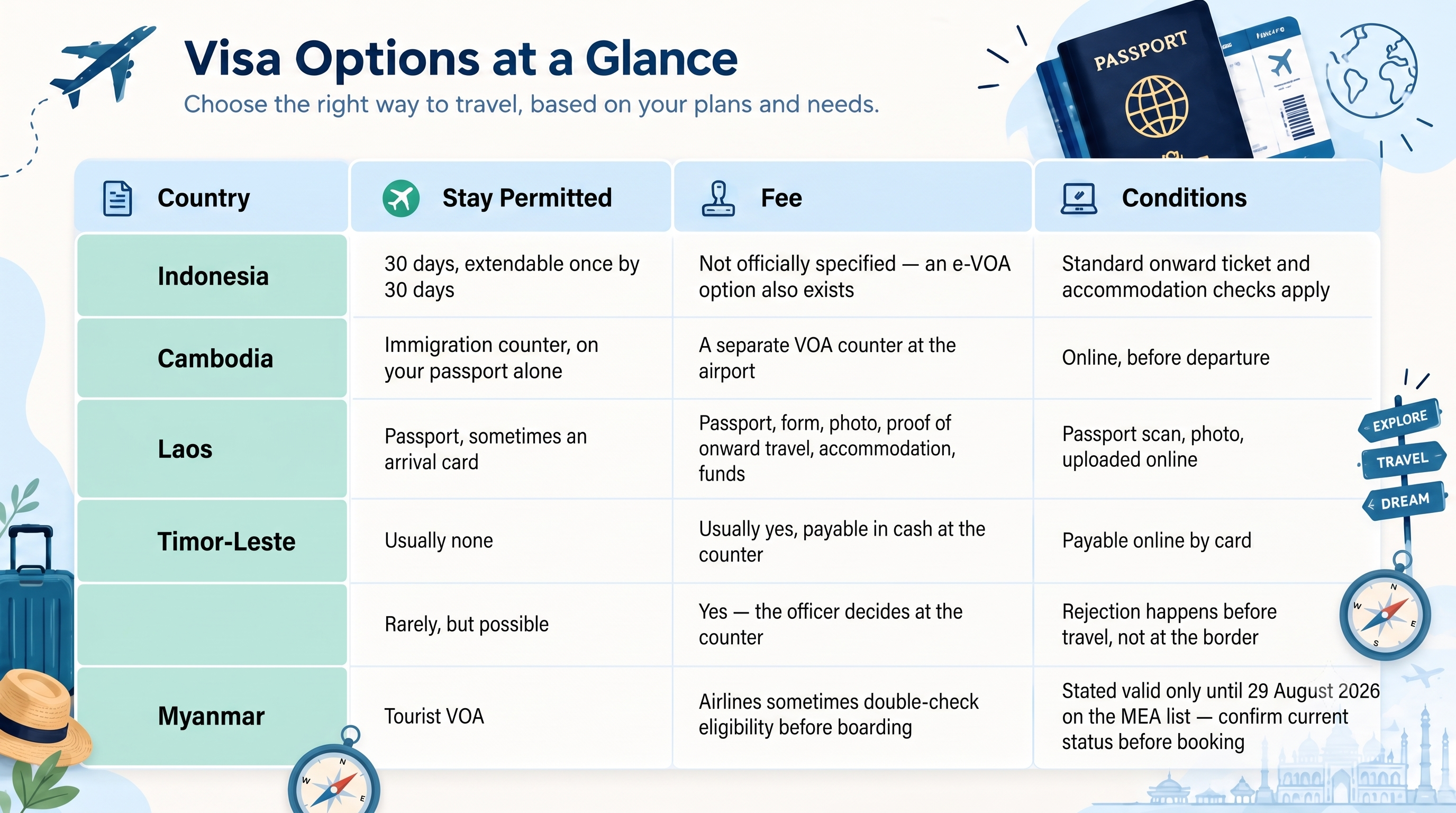
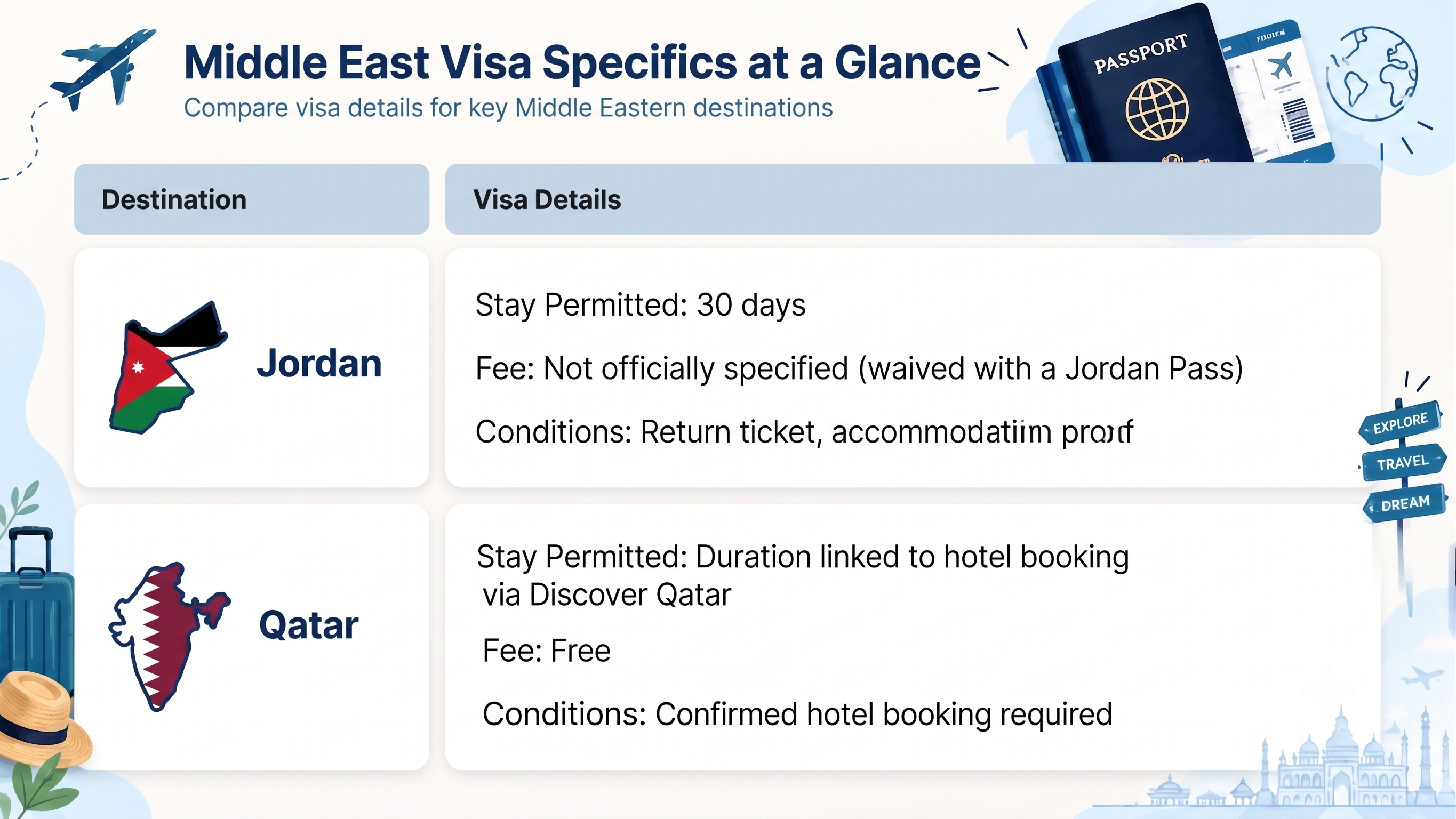
The Ministry of External Affairs, Government of India publishes an official country-wise list of visa facilities available to Indian ordinary passport holders. The table below is drawn from that list (reviewed 2 February 2026) and organised by region for readability. Fees and stay durations shown are only stated where the government source specifies them - where no figure is published, that is noted rather than estimated.
Asia & Southeast Asia
Middle East
Africa
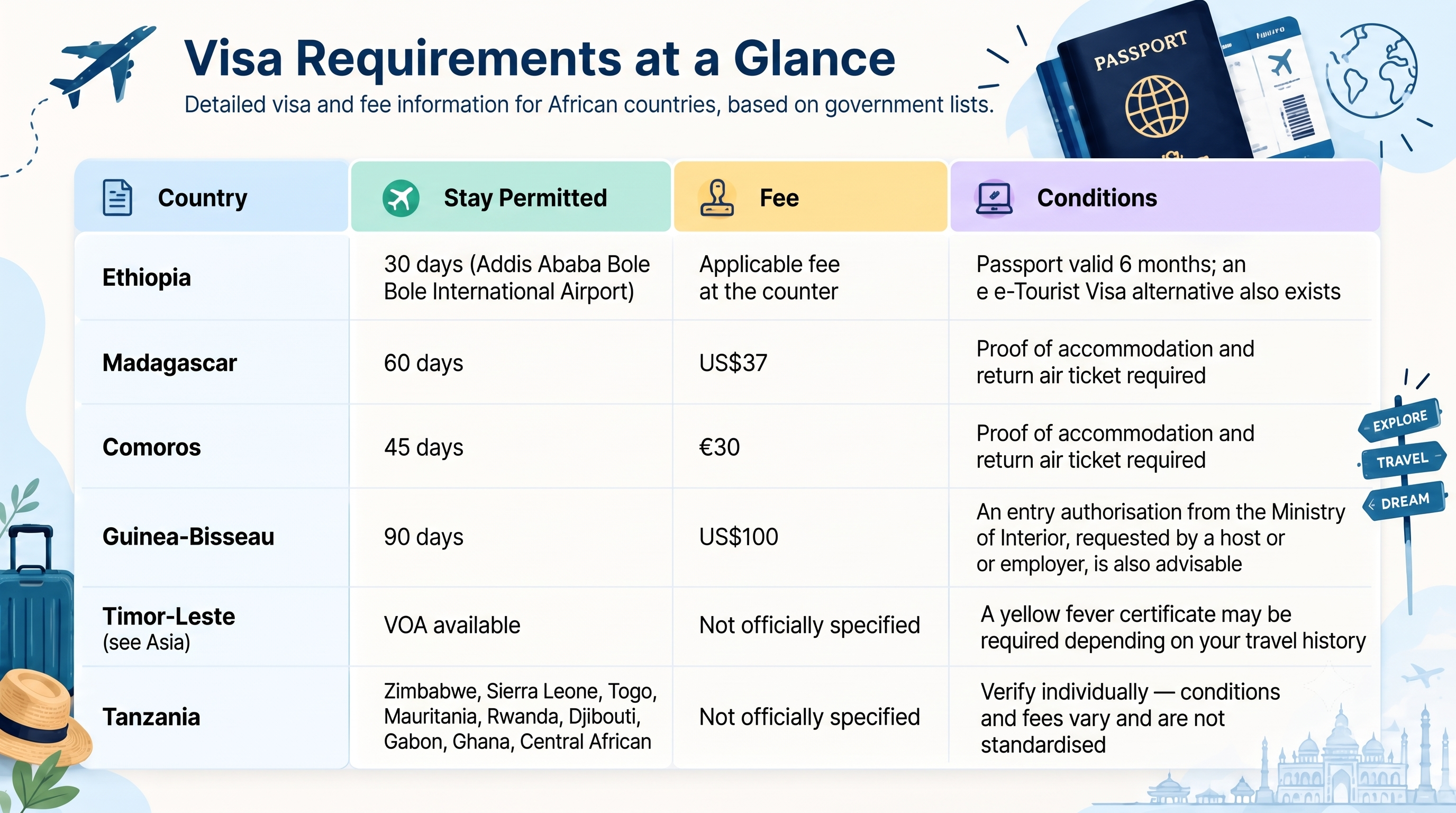
Caribbean & Pacific
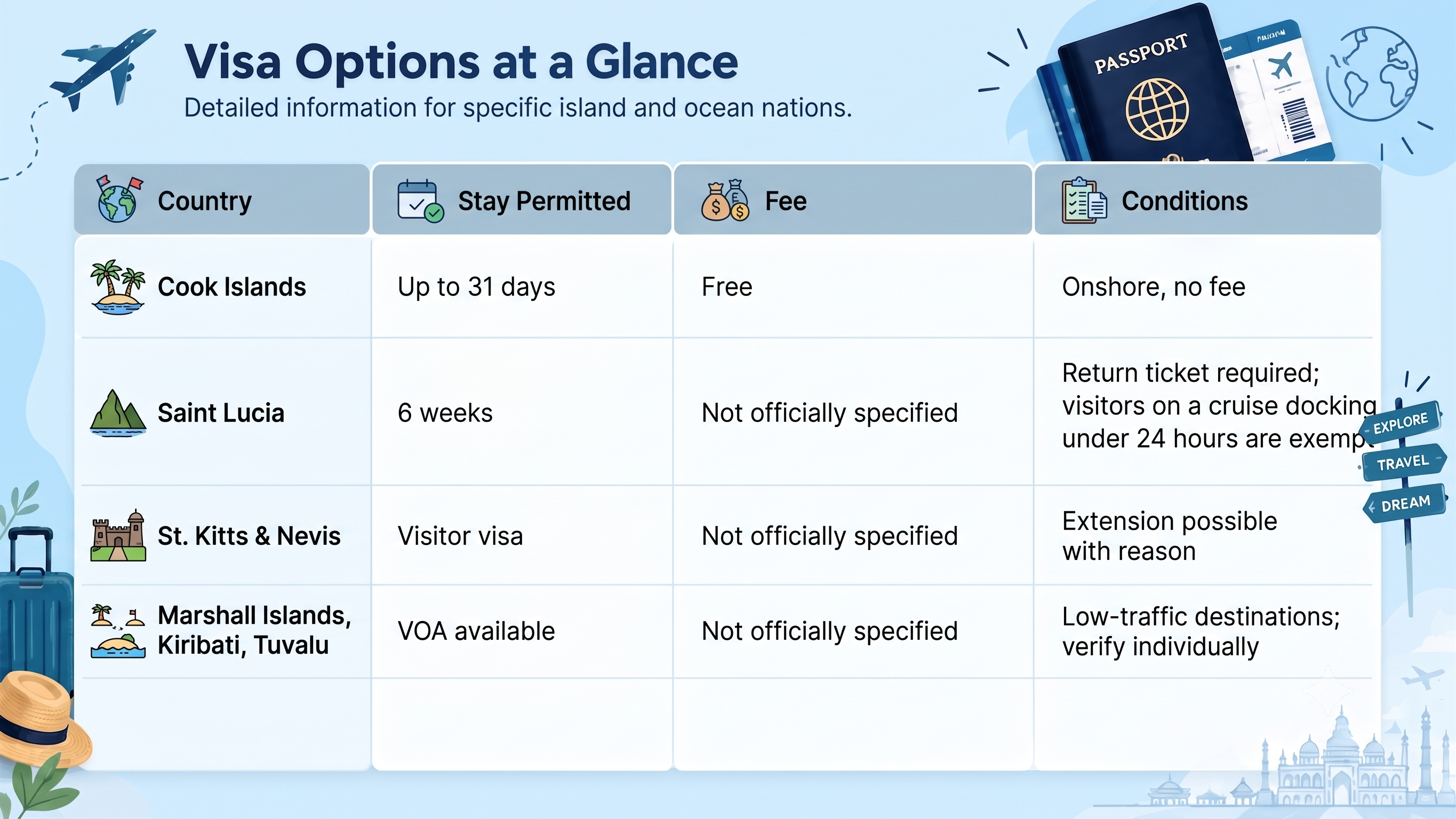
Latin America
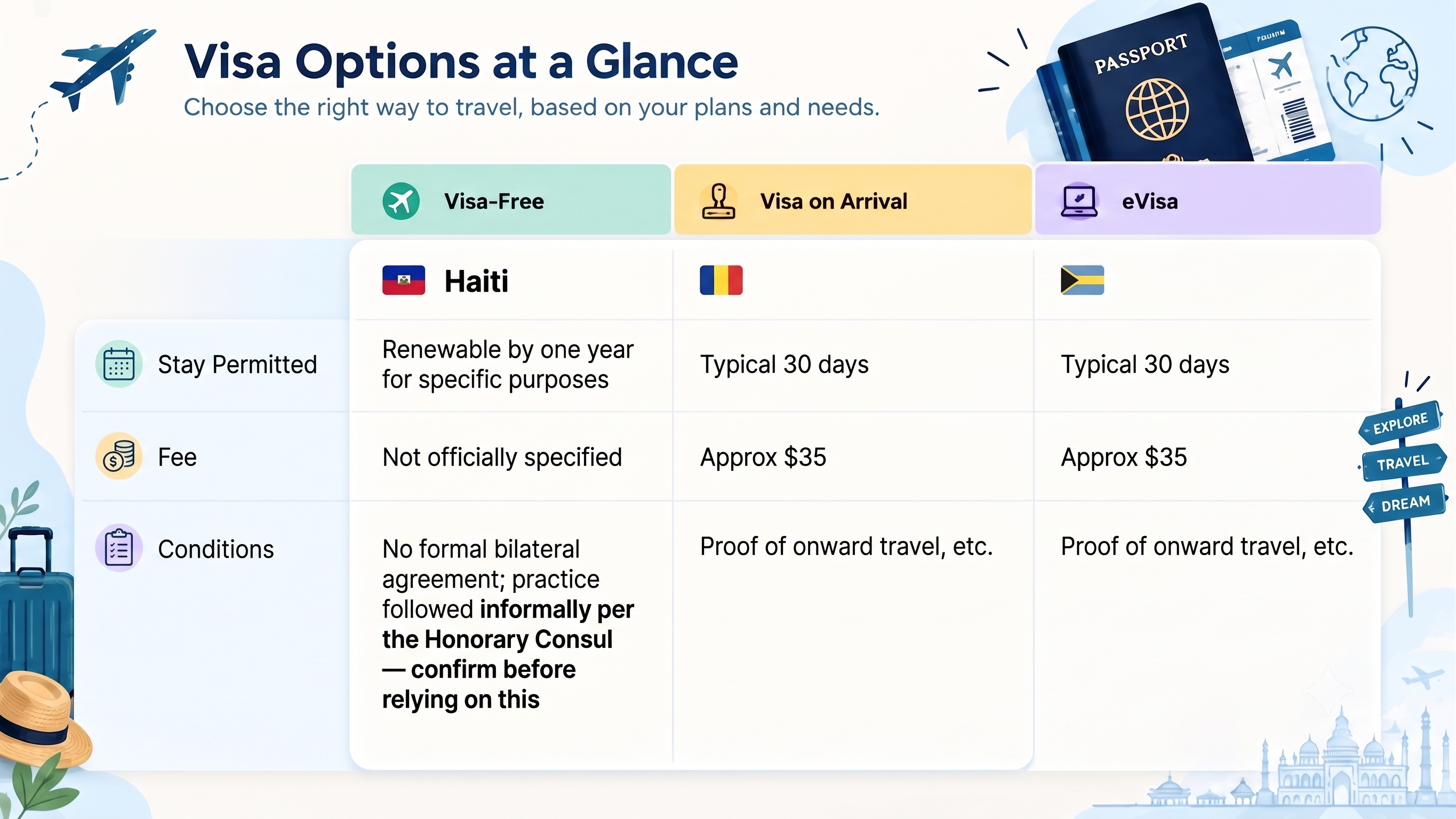
Conditional Visa on Arrival: Countries That Need an Existing US/UK/Schengen Visa
This is the part of "visa on arrival" that catches the most Indian travellers out - because these countries are frequently listed as "VOA for Indians" without the condition attached, and the condition is the whole story.
Several popular Middle Eastern and neighbouring destinations only extend visa-on-arrival to Indian passport holders who already hold a valid visa or residence permit from a specified list of countries - typically the US, UK, EU/Schengen area, Canada, Australia, New Zealand, Japan, Singapore or South Korea. Without one of those, you cannot get a VOA at these counters - you would need to apply for a visa through the normal advance channel instead.
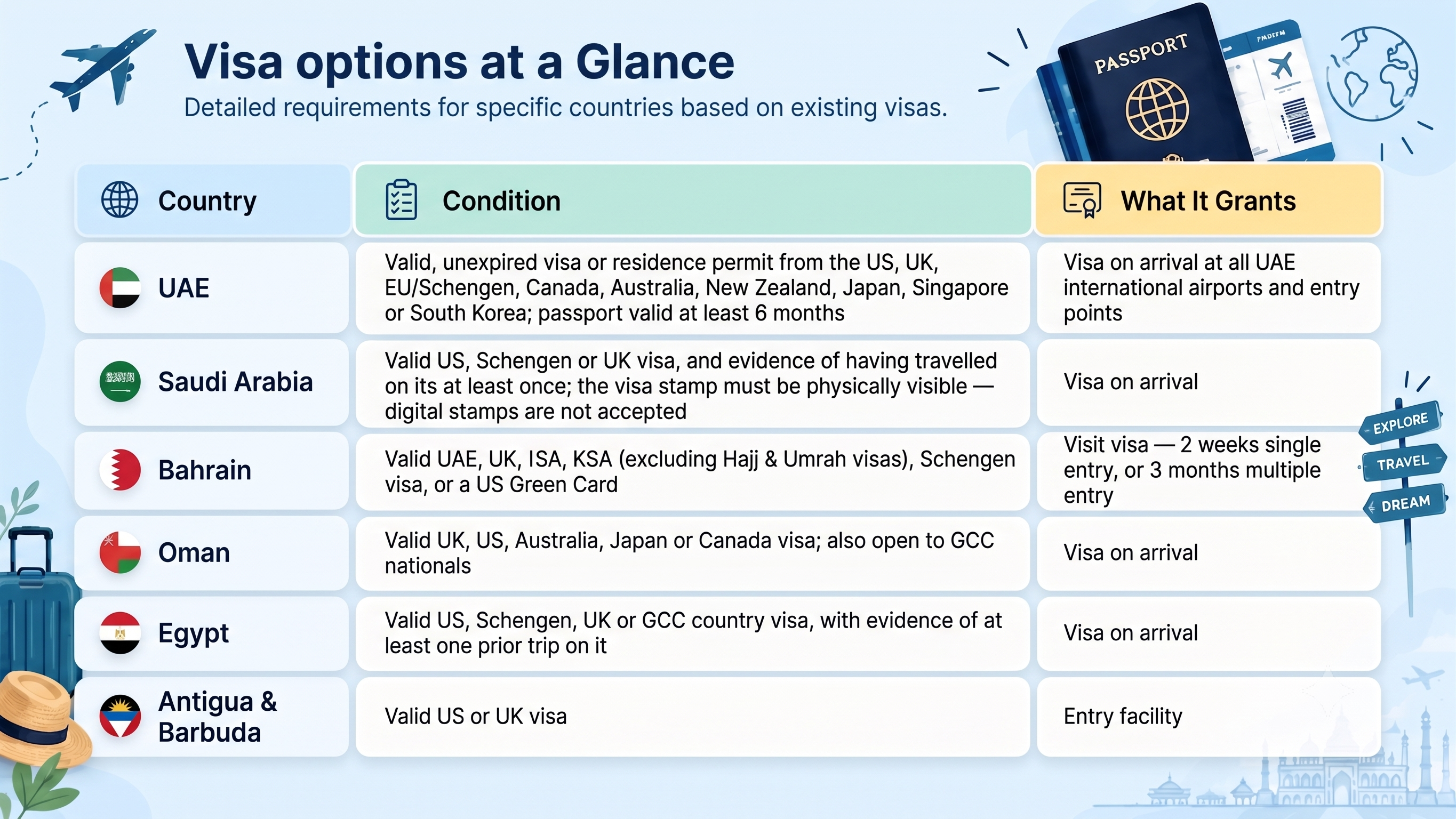
If you don't hold one of these qualifying visas, none of the above apply to you as a VOA route. This is the single most common misunderstanding in "visa on arrival" content aimed at Indians - a country appears on a VOA list, but the traveller discovers at check-in that the facility only applies to a subset of passengers.
Documents You Need at the Counter
Visa-on-arrival eligibility only means you may apply at the border - the officer still decides. Carry the following, printed rather than only on your phone:
- Passport valid for at least six months beyond your arrival, with at least two blank pages
- Confirmed return or onward ticket
- Proof of accommodation for the full stay - a hotel booking, or a host's address and invitation
- Proof of funds - cash, a card, or a recent bank statement, to whatever level the counter asks for
- Passport-size photographs, where the visa is issued as a physical sticker
- A completed arrival form, usually filled during the flight or at a kiosk before the counter
- A yellow fever certificate, where you are arriving from a country where it is endemic (several African VOA counters check this specifically)
- Travel insurance certificate, where the destination asks for it - not universal, but increasingly common
Know your first night's accommodation address before you land - most arrival forms ask for it, and hesitating over this at the counter is a common trigger for further questioning.
Visa on Arrival Fees - What to Carry and How to Pay
- Most VOA fees are payable in cash, and the accepted currency is frequently US dollars, exact change preferred. Card acceptance at these counters is inconsistent - do not rely on it.
- Fees range from free to a moderate amount, depending on the destination. Free arrival visas (such as Qatar and the Cook Islands) tend to come with the strictest document checks, since there is no fee to act as a filter.
- Where an eVisa alternative exists for the same country (Indonesia, Ethiopia, Cambodia, Laos, Mongolia and others all offer one), it is usually worth taking instead - it removes the uncertainty of a counter decision and often takes only a few minutes online.
- Fees are set by the destination and are subject to change. This guide does not quote a fixed rupee-equivalent for any country, because the underlying fee is denominated in foreign currency or local currency and revised independently of anything published in India.
Why a Visa on Arrival Can Still Be Refused
Eligibility is not approval. The immigration officer at the counter makes the final call, and refusals happen for predictable, avoidable reasons:
No return or onward ticket. The single most common reason.
Unproven accommodation. Staying with friends or relatives without a letter or address on hand.
Insufficient funds, or an inability to demonstrate them - "I have a card" is not always accepted as proof.
Passport problems - less than six months' validity, no blank pages, visible damage, or a name that doesn't match your ticket.
Arriving at the wrong entry point. Several countries issue VOAs only at specific international airports, not at every land or sea border.
Missing the conditional-visa requirement described above - arriving at a UAE, Saudi, Bahrain, Oman or Egypt counter without the qualifying US/UK/Schengen visa.
Airline boarding denial before you even reach immigration. Airlines apply entry rules conservatively at check-in in India, and more boarding refusals happen at the check-in desk than actual visa refusals happen at the destination.
Carrying your documents printed, plus a copy of the destination's official VOA rule (screenshotted or printed from the government site), resolves most counter conversations before they become a problem.
Countries Recently Changed - Read This Before You Book
Visa policy for Indian travellers has been unusually active through 2026. A few changes are important enough to flag directly, because older content - including some still-ranking articles - has not caught up:
- Sri Lanka has moved away from visa on arrival. Since 25 May 2026, Sri Lanka issues a free Electronic Travel Authorisation (ETA) to Indian nationals rather than a counter visa - applied for online before travel, valid for 30 days on a double-entry basis, with approval typically within 24 to 72 hours. If your source still lists Sri Lanka as a VOA country, it is out of date.
- Thailand and Malaysia are not visa-on-arrival countries for Indians. Both are visa-free for tourism (Thailand: 30 days from 15 September 2026, Malaysia: 30 days, exemption confirmed to 31 December 2026), each requiring a mandatory digital arrival registration rather than a counter visa or fee. See our [Thailand E-Visa and Visa Exemption Guide] for the full detail.
- Bolivia has moved away from a visa-on-arrival arrangement and now generally requires an advance visa or eVisa for Indian travellers.
- Cabo Verde now requires online pre-registration on its EASE platform, with the visa itself still issued on arrival subject to that registration and the applicable fee.
- Myanmar's tourist VOA is stated on the official MEA list as valid only until 29 August 2026 - confirm its status directly before relying on it for any travel booked after that date.
The pattern across all of these: a list that was accurate six months ago can be actively misleading today. This is the strongest argument for checking the destination's own immigration source in the week before you travel, not just before you book.
Visa on Arrival vs eVisa - Which to Choose When Both Exist
For several countries on this list, you genuinely have a choice between applying at the airport counter or securing an eVisa before you fly. Where that choice exists, the eVisa is usually the better option:
- Certainty before departure. An approved eVisa means you already know you can enter, rather than finding out at the counter.
- No queueing. VOA counters at busy airports can involve long waits, especially during peak season.
- No cash requirement. eVisa fees are paid online by card; VOA fees are usually cash only.
- A paper trail. An eVisa approval email is easier to produce again if anything is questioned later.
The trade-off is that an eVisa must be arranged in advance and is sometimes restricted to specific ports of entry - check that your arrival airport is on the approved list before relying on it.
If your destination's process moves entirely online, our [Vietnam eVisa Official Portal and Application Steps] and [VFS Global Appointment Booking & Login Portal] guides cover what that process looks like end to end.