International Tourist Visa Guide for Indians: Requirements, Documents, Fees & Application Process
International Tourist Visa Guide for Indians: Requirements, Documents, Fees & Application Process
Every year, lakhs of Indian travellers book an international holiday and then discover that the hardest part is not choosing the destination. It is working out what paperwork that destination actually wants.
The confusion is understandable. One country stamps your passport on arrival and asks nothing. Another wants six months of bank statements, an employer's letter, a hotel booking and a fingerprint appointment booked three weeks in advance. There is no single rulebook, because every government writes its own.
This International Tourist Visa Guide for Indians is designed to remove that confusion. It explains what a tourist visa is, the five different ways an Indian passport holder can be admitted into a foreign country, what documents are commonly asked for and why, how financial proof is actually assessed, what the application process looks like step by step, and where the real delays come from.
A quick word on why rules vary so much. Countries set entry policies based on bilateral agreements, tourism strategy, immigration history and security considerations. The Indian passport sits in the middle of the global mobility range - comfortable access to a reasonable number of destinations, with several popular holiday countries still requiring a full advance application. Those positions shift. Thailand, for example, changed its arrangement for Indian travellers twice during 2026.
That is exactly why the most important habit in this entire guide is the simplest one: before you apply or book anything, open the official embassy or immigration website for your destination and read the current rule yourself. Everything here is designed to help you understand what you are reading there.
What Is an International Tourist Visa?
A tourist visa is written permission from a foreign government allowing you to travel to that country for leisure, for a limited period.
Think of it as a document that answers one question for the destination country: is this person a genuine short-term visitor?
Why countries issue tourist visas
Governments use visas to manage who enters their territory. A visa lets them check identity, purpose of travel, financial capacity and immigration history before a traveller arrives, rather than at a busy airport counter. It also creates a record that can be checked later.
What a tourist visa generally permits
- Sightseeing and holidays
- Visiting friends and relatives
- Short recreational travel
- Attending a family function, in most cases
- Limited incidental activity such as attending a conference as an observer, where the country allows it
What a tourist visa generally does not permit
- Paid work, freelancing or any revenue-generating activity
- Enrolling in a long-term course of study
- Seeking permanent residence
- Accessing public funds or free public healthcare
- Staying beyond the permitted period
- Business activity, where a separate business visa category exists
Using a tourist visa for a purpose it does not cover is treated seriously and can affect every future application you make, anywhere.
Visa validity vs permitted stay - the difference that catches people out
These two terms sound similar and mean very different things.
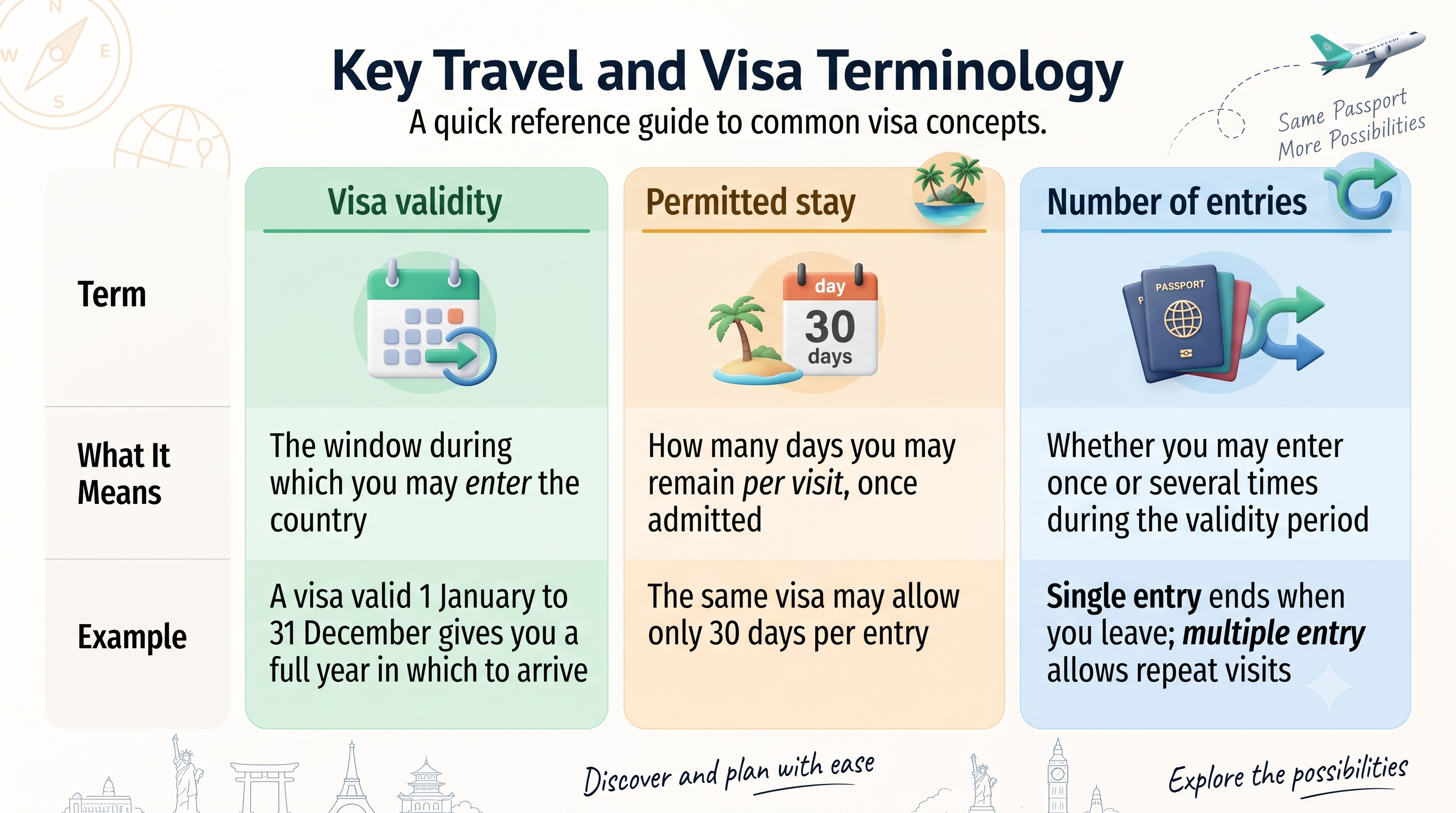
A visa valid for one year does not mean you can stay for one year. The permitted stay is usually printed on the visa sticker or in the approval notice, and it is the figure that immigration enforces. Overstaying by even a few days can lead to fines, deportation and future refusals.
Do Indians Need a Visa to Travel Abroad?
Sometimes yes, sometimes no. It depends on the destination, your purpose of travel, how long you plan to stay, and occasionally on which other visas you already hold.
For destination-specific visa assistance, see our visa services for 100+ countries.
There are six situations an Indian traveller can encounter.
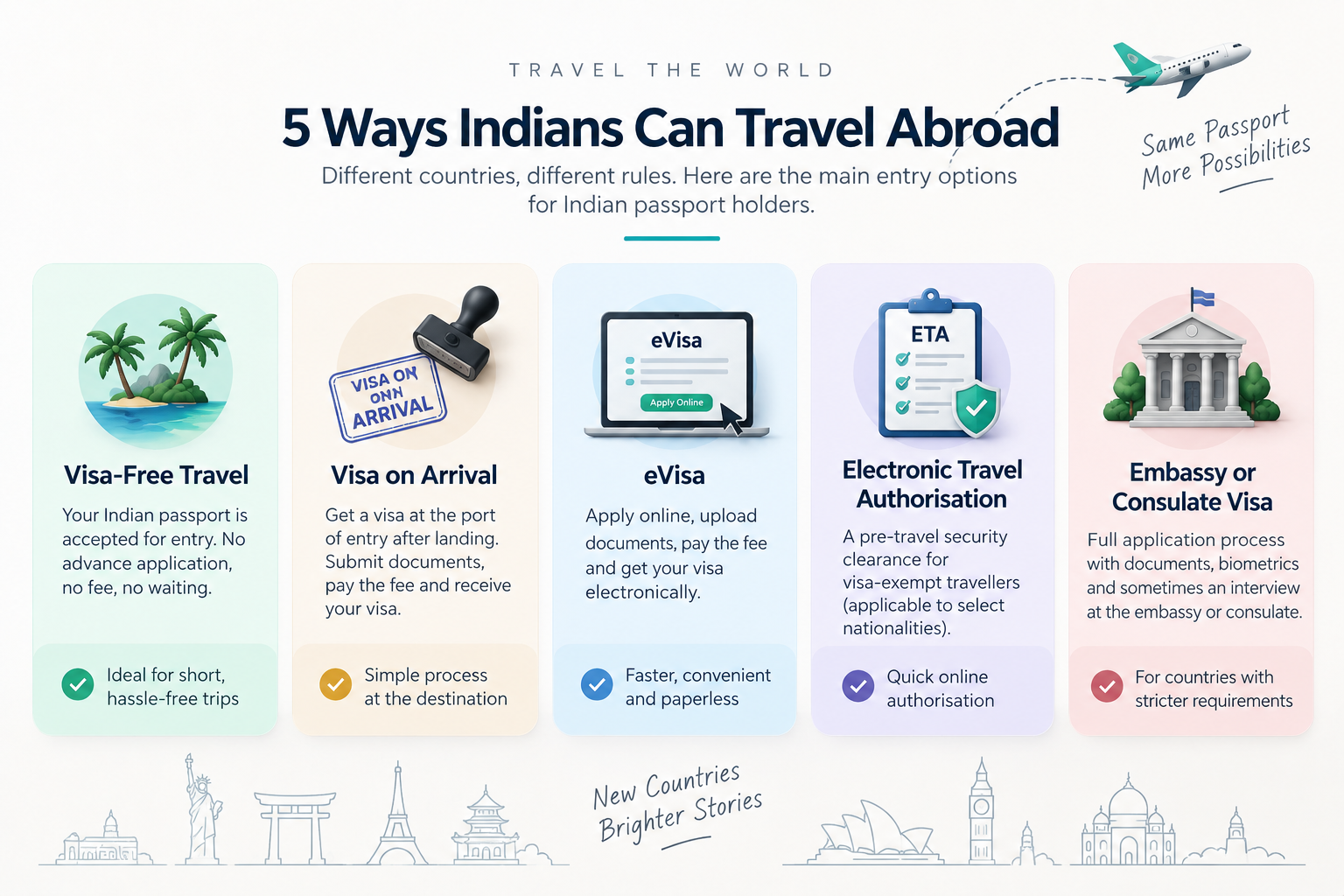
Visa-Free Travel
Your Indian passport alone is accepted for entry. No advance application, no fee, no waiting.
How it works: You board your flight, land, present your passport at immigration and receive an entry stamp for a fixed number of days.
What still applies: Passport validity requirements, blank passport pages, proof of onward travel, proof of accommodation, sufficient funds, and any arrival card or health declaration the country requires.
Best suited to: Short, simple holidays and last-minute trips.
The caution: Visa-free status is the most volatile category of all. Countries add and remove nationalities regularly. A destination that was visa-free for Indians last season may not be this season.
Visa on Arrival
You are eligible to receive a visa at the port of entry, without applying beforehand.
How it works: After landing, you join a separate visa-on-arrival counter, submit a short form and a photograph, pay the fee, and receive a sticker or stamp.
Practical points:
- Eligibility is decided in advance by policy; the visa itself is issued at the counter
- The officer at the counter can still refuse entry
- Queues at busy airports can be long - budget an extra hour or more
- Carry cash in the accepted currency as well as a card; payment methods vary
- Many countries want to see a return ticket and hotel booking at this counter
For a destination-wise view, see our guide to visa on arrival countries for Indian passport holders.
eVisa
An eVisa for Indians is a real visa, applied for online and issued electronically. It is not a lighter form of permission - it is the same authorisation, delivered digitally.
How it works: You apply on the destination government's official eVisa portal, upload a passport scan and photograph, pay online, and receive an approval by email which you print or carry on your phone.
Advantages: No travel to a visa application centre, no passport submission, faster turnaround, and a clear record.
Cautions:
- Fake eVisa websites are widespread. Many rank above the official portal in search results and charge several times the government fee. Always reach the portal through the destination government's own domain or its embassy website in India.
- eVisas are often restricted to specific ports of entry - check whether your arrival airport or land border qualifies
- Many are single entry only
- Name spelling must match your passport exactly
Electronic Travel Authorisation
An ETA is a pre-travel security screening rather than a visa. It exists so that countries can run checks on travellers who are otherwise visa-exempt, before they board.
The key point for Indian travellers is this: ETAs generally apply to nationalities that do not need a visa for that country. If a country requires Indians to hold a visa, the ETA route usually does not apply to you.
Europe's upcoming ETIAS system is the clearest example. It is meant for visa-exempt nationalities. Indian passport holders are on the European Union's visa-required list, and will continue to apply for a Schengen short-stay visa rather than an ETIAS authorisation. This is worth knowing because a great deal of online content about ETIAS is written for American, British and Australian readers and does not apply to Indians at all.
Embassy or Consulate Visa
The full, traditional application: a complete document file, an application form, a biometric appointment, and sometimes an interview at the embassy or consulate.
This is the route for destinations that assess intent closely - the United States, United Kingdom, the Schengen Area, Australia, Canada and Japan among them. These countries want to be satisfied that you are a genuine tourist who will return to India. That is why financial documents, employment proof and travel history matter so much here, and so little in the other categories.
VFS-Assisted Visa Application
Most embassy visas in India are not submitted at the embassy itself. They are submitted at a visa application centre operated by an outsourcing partner such as VFS Global, BLS International or TLScontact.
What the centre does: Accepts your application and documents, captures fingerprints and a photograph, collects fees, and returns your passport.
What the centre does not do: Decide your visa. That decision sits with the country's consular authority.
We cover this distinction in detail in our VFS Global appointment booking and login guide.
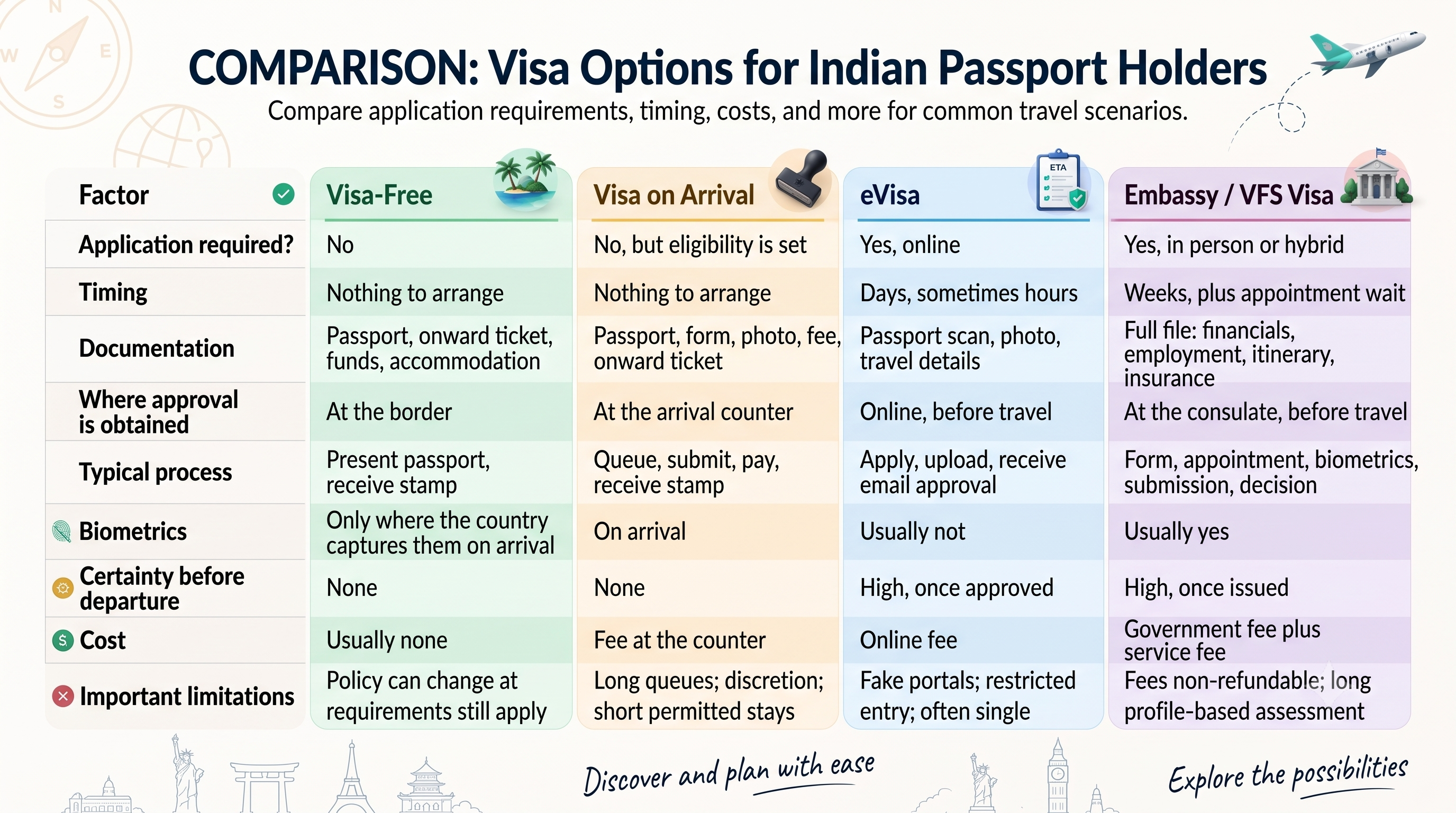
Entry type comparison
Visa-free does not mean "no requirements"
This is the single most misunderstood point in international travel.
A visa waiver removes the requirement to obtain a visa. It does not remove the destination's other entry requirements. Even on a visa-free arrival, an immigration officer at border control may ask to see a return ticket, a hotel booking, evidence of funds, or insurance.
A live example: Thailand has required every arriving foreign national to complete a digital arrival card online before arrival since May 2025, and this applies even to travellers who need no visa at all. Airlines check for it at boarding. Similarly, Europe's biometric Entry/Exit System became operational at Schengen external borders in April 2026, replacing passport stamping with fingerprint and facial registration for non-EU travellers - including Indians who already hold a valid Schengen visa.
In short: a visa waiver is a paperwork waiver, not a scrutiny waiver.
Tourist Visa Requirements for Indians
Across destinations, the same broad categories of evidence come up again and again. Here is what is commonly asked for, and the reason behind each.
There is no single universal tourist-visa checklist. Requirements depend on the destination, the visa category and the applicant's profile. A Vietnam eVisa may need only a passport scan and a photograph. A UK Standard Visitor application may need a detailed financial history. Preparing the wrong file wastes time in one direction and causes refusal in the other.
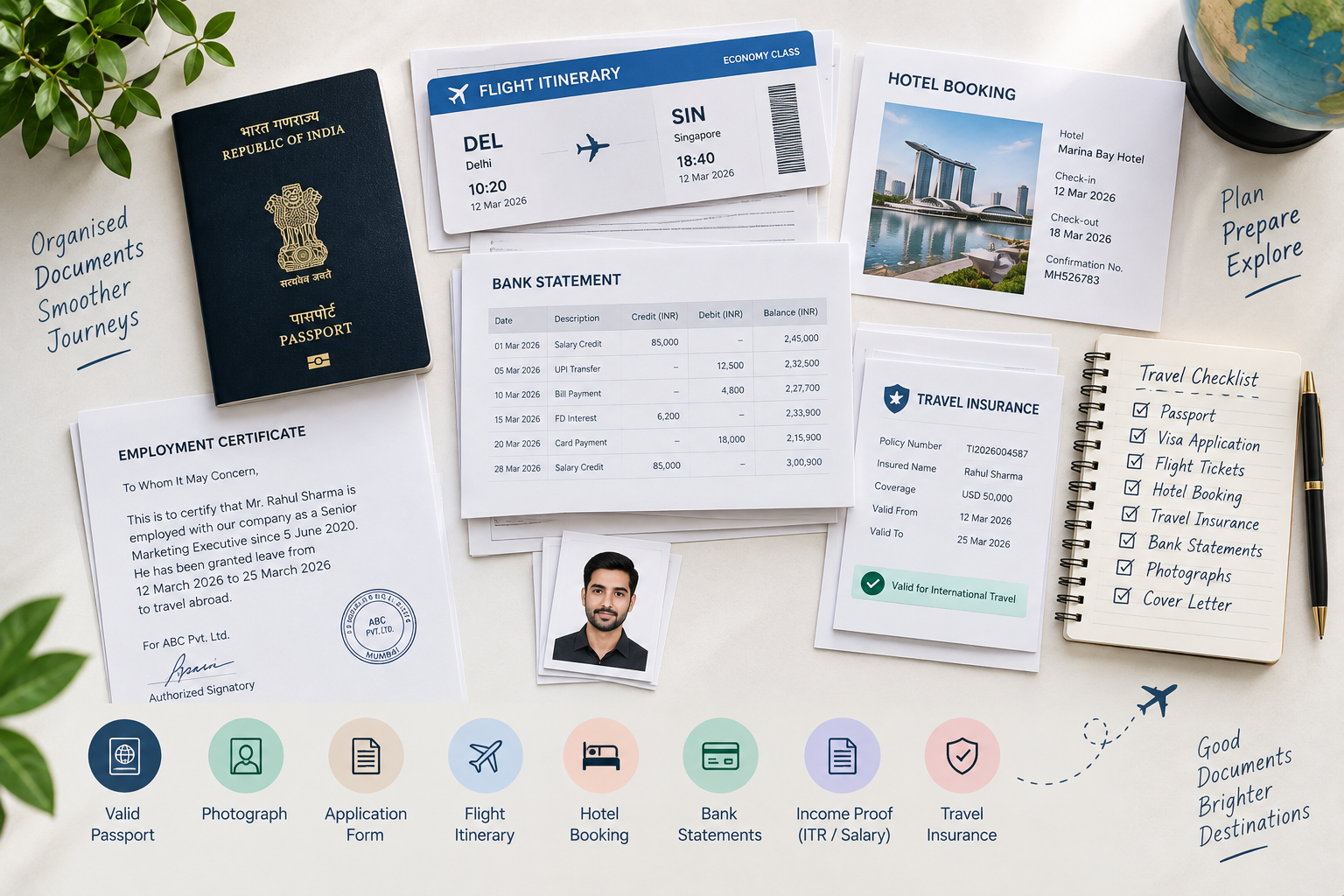
Tourist visa documents required for Indian travellers
Tourist Visa Documents Required for Indian Travellers
This section explains each document properly - what is actually checked, and what commonly goes wrong.
Passport
Your passport is the foundation of the application. Check it first, because it is the one problem that cannot be fixed quickly.
- Validity: Most destinations require at least six months' validity beyond your intended date of departure from that country. Some require validity beyond your date of entry. Renewal through Passport Seva takes time, so check early.
- Blank pages: Many missions require at least two, sometimes three, completely blank pages for the visa and entry stamps. Pages carrying only endorsements may not count.
- Damaged passports: Water damage, torn pages, a loose binding or a damaged data page can lead to rejection at submission or refusal of boarding. If your passport is damaged, apply for a replacement rather than hoping it passes.
- Previous passports: If your earlier visas or travel stamps are in an old passport, carry it. Many missions ask for old passports specifically to assess travel history. If an old passport was lost, a copy of the police report and the relevant declaration may be required.
- Personal particulars: Name, date of birth and address on the passport must match every other document you submit. Mismatches - a maiden name, an initials-only surname, a spelling variation - should be explained with supporting documents.
Photograph
This sounds trivial and causes a surprising number of delays. Photo specifications are set by each country and are enforced strictly.
Typically checked: exact dimensions, background colour, head size as a proportion of the frame, neutral expression, both eyes visible, no shadows, recent (usually within the last three to six months), no spectacle glare, and specific rules on head coverings worn for religious reasons.
Do not reuse an old photograph. Get fresh photographs taken to the exact published specification for your destination, and carry spares to the appointment.
Visa Application Form
Fill the form yourself, slowly. Key points:
- Every detail must match your passport exactly
- Do not leave mandatory fields blank; write "not applicable" where a field genuinely does not apply
- If asked about previous visa refusals, answer truthfully - a concealed refusal that surfaces later is far more damaging than a declared one
- Sign where required; unsigned forms are routinely returned
- Save your reference number, which you will need for visa tracking
Flight Itinerary
Most destinations want to see travel dates, not a paid ticket.
- Many missions accept a flight reservation or dummy itinerary from an airline or agent
- Some require confirmed bookings - check the official checklist before paying
- Dates on the itinerary must match the dates on your form, cover letter and insurance
- Avoid buying non-refundable tickets before the visa is issued wherever the rules permit
Hotel / Accommodation Proof
- A confirmed hotel booking covering every night of the trip is the standard
- If staying with friends or relatives, an invitation letter with the host's address, ID proof and often proof of their residence status
- The accommodation should cover the full itinerary, with no unexplained gaps
- Use refundable bookings where possible until the visa is granted
Bank Statements
The core financial document, and the one that is read most carefully.
- Usually the last three to six months, stamped and signed by the bank, or an authenticated digital statement
- The account holder's name must match the applicant, or the sponsorship must be documented
- Officers read the pattern, not just the closing balance: regular credits, steady balances, and spending consistent with the stated lifestyle
- Statements should be recent - many missions reject statements more than a few weeks old at submission
ITR
Income tax returns, usually for the last two or three assessment years, are valued because they are independently filed with the Government of India and are difficult to fabricate.
For self-employed applicants, ITRs often carry more weight than bank statements alone. If you have not filed for a year, be prepared to explain why.
Salary Slips
Typically the last three to six months. The net figure on the slip should reconcile with the salary credit in your bank statement and with the figure in your employment letter. Discrepancies between these three documents are noticed.
Employment Proof
A letter on company letterhead confirming designation, date of joining, current salary, and - where relevant - that your position continues after the trip. It should carry a contactable signatory, a company stamp and a date.
For business owners: business registration, GST registration, trade licence, audited or CA-certified financials, and current account statements.
Leave Approval
A short letter from your employer sanctioning leave for the exact travel dates. This supports the argument that you intend to return. The dates must match your itinerary precisely - a leave letter that ends before your return flight is a visible inconsistency.
Cover Letter
Optional for most destinations, but genuinely useful. A good cover letter is one page and covers:
- Who you are and what you do
- Where you are going, when, and why
- A brief day-wise outline of the itinerary
- Who is paying, and how
- An explanation of anything unusual in your file - a large deposit, a gap in employment, a name mismatch
- Your ties to India and your intention to return
Keep it factual. It is not a persuasive essay; it is a summary that saves the officer from guessing.
Travel Insurance
Mandatory for some destinations, strongly advisable everywhere. Covered in detail in its own section below.
Previous Travel History
Prior visas and entry stamps - particularly for the United States, United Kingdom, Schengen countries, Japan, Australia and Canada - demonstrate that you have travelled before and returned on time. Carry old passports, or copies of the relevant visa pages.
A clean travel history is an asset. A history containing an overstay or a refusal needs to be explained rather than hidden.
Sponsorship / Invitation Documents
Where someone else funds the trip:
- A signed sponsorship letter stating the relationship, the trip and exactly what is being covered
- The sponsor's bank statements, ITR and income proof
- The sponsor's identity and residence documents
- Relationship evidence - birth certificate, marriage certificate or family records
Where a host in the destination country invites you:
- An invitation letter with their full address and contact details
- Their identity or residence proof
- Confirmation of who is paying for what
Some countries have a prescribed sponsorship or invitation form that must be used instead of a free-form letter. Check the official checklist.
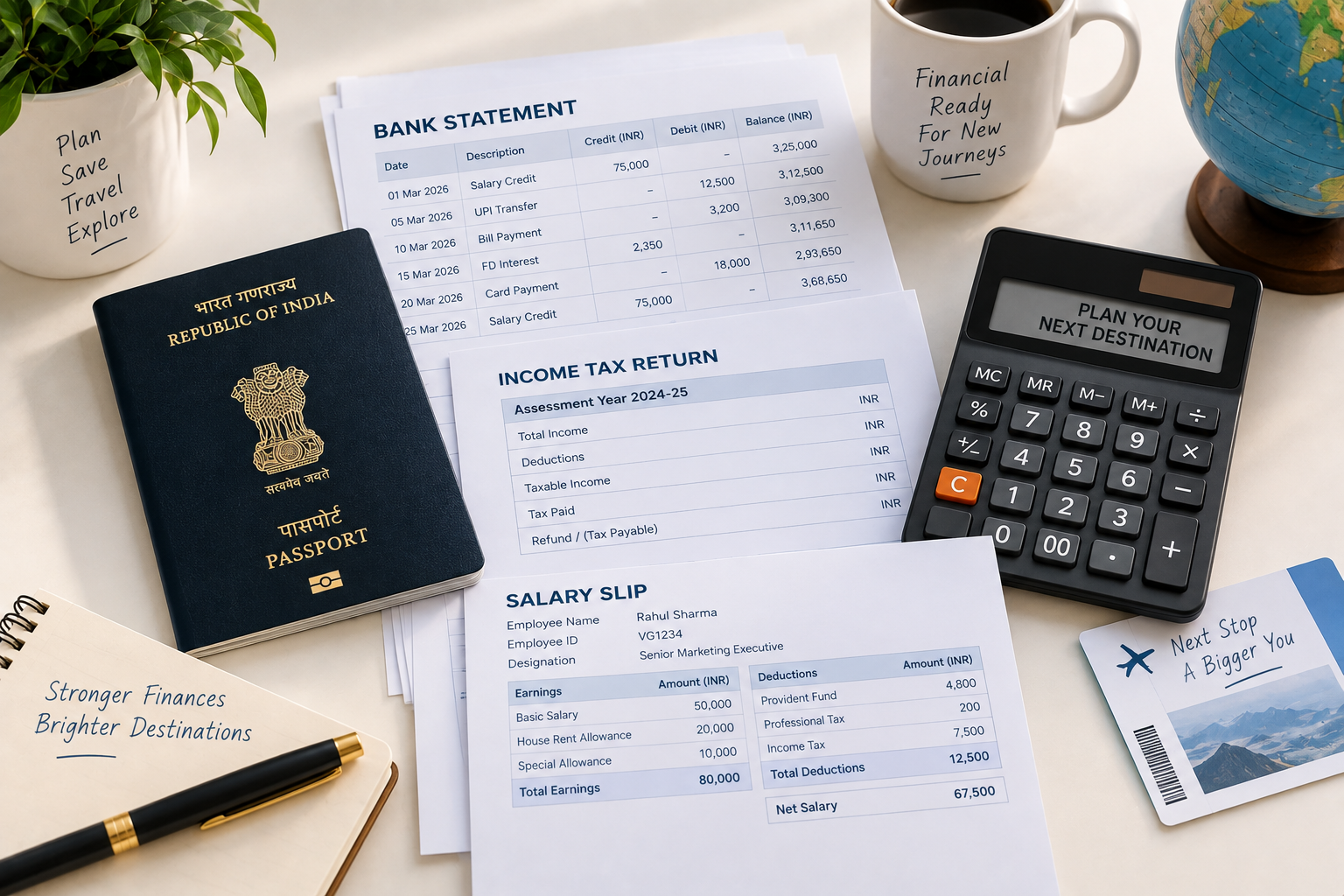
How Much Bank Balance Is Required for a Tourist Visa?
This is one of the most searched visa questions in India, and one of the most badly answered.
The honest answer
There is no single universal minimum bank balance that applies to every country. You will find blog posts and social media videos quoting one fixed rupee figure "required for a tourist visa". Treat these with caution.
What is actually true:
- Some countries publish a specific figure - a daily amount, or a total amount, that a visitor should be able to show. These are set by that government, published officially, and revised from time to time.
- Many countries publish no figure at all and assess sufficiency case by case, against your declared itinerary.
- Some check funds at the border rather than at the application stage.
- The reasonable amount depends on your trip. Funds appropriate for five days in a neighbouring country are not appropriate for three weeks across Europe.
The right approach is not to chase a number from a forum. It is to build a realistic budget for your actual trip, show that your funds comfortably cover it, and check whether your specific destination publishes a minimum on its official immigration website.
Why embassies ask for financial proof
The officer is answering three questions at once:
Can you afford this trip without relying on unauthorised work or public funds?
Is the trip consistent with your life - does a person with your income plausibly take this holiday?
Do you have reasons to return to India - income, employment, business, family, property?
Financial documents answer all three. That is why they carry so much weight.
Acceptable forms of financial evidence
- Bank statements - the primary evidence, usually three to six months
- Salary slips - corroborating regular income
- ITR - independent verification across years
- Employment or business proof - the source of the income
- Sponsorship documents - where someone else funds the trip, their financials are assessed
- Fixed deposits and investments - accepted as supporting evidence by some destinations; rarely a substitute for liquid funds. Verify whether yours counts them.
- Property documents - generally treated as evidence of ties rather than of spending capacity
What makes financial documents look consistent?
This is where applications are genuinely won or lost.
Regular income. An account showing steady salary or business credits over several months reads as a real working person's account.
Reasonable travel expenses. Your itinerary should be one your income could plausibly support. A luxury European trip declared by an applicant whose statements show modest, irregular activity invites questions.
Consistent account activity. Normal usage - utility payments, card spends, transfers, EMIs - builds credibility. An account that was dormant and then suddenly funded does the opposite.
Genuine transactions. Circular transfers between accounts, round-figure deposits appearing weekly, or money moved in and then straight out again are patterns officers recognise.
Explainable large deposits. A big lump sum shortly before applying is the most common financial red flag in Indian applications. This does not mean large deposits are prohibited. It means they should be explained. If you sold a vehicle, received a bonus, matured a fixed deposit or were gifted travel funds by a family member, say so in your cover letter and attach proof. An explained deposit is far better than an unexplained one.
Income matching the proposed trip. Your salary slips, bank credits, ITR and employment letter should tell one coherent story, and that story should make your planned holiday look affordable.
A necessary caution
Strong financial documentation improves the quality of an application. It does not guarantee an outcome. Visa decisions rest entirely with the issuing authority, take the whole profile into account, and cannot be promised by any guide, agent or consultancy - including this one.
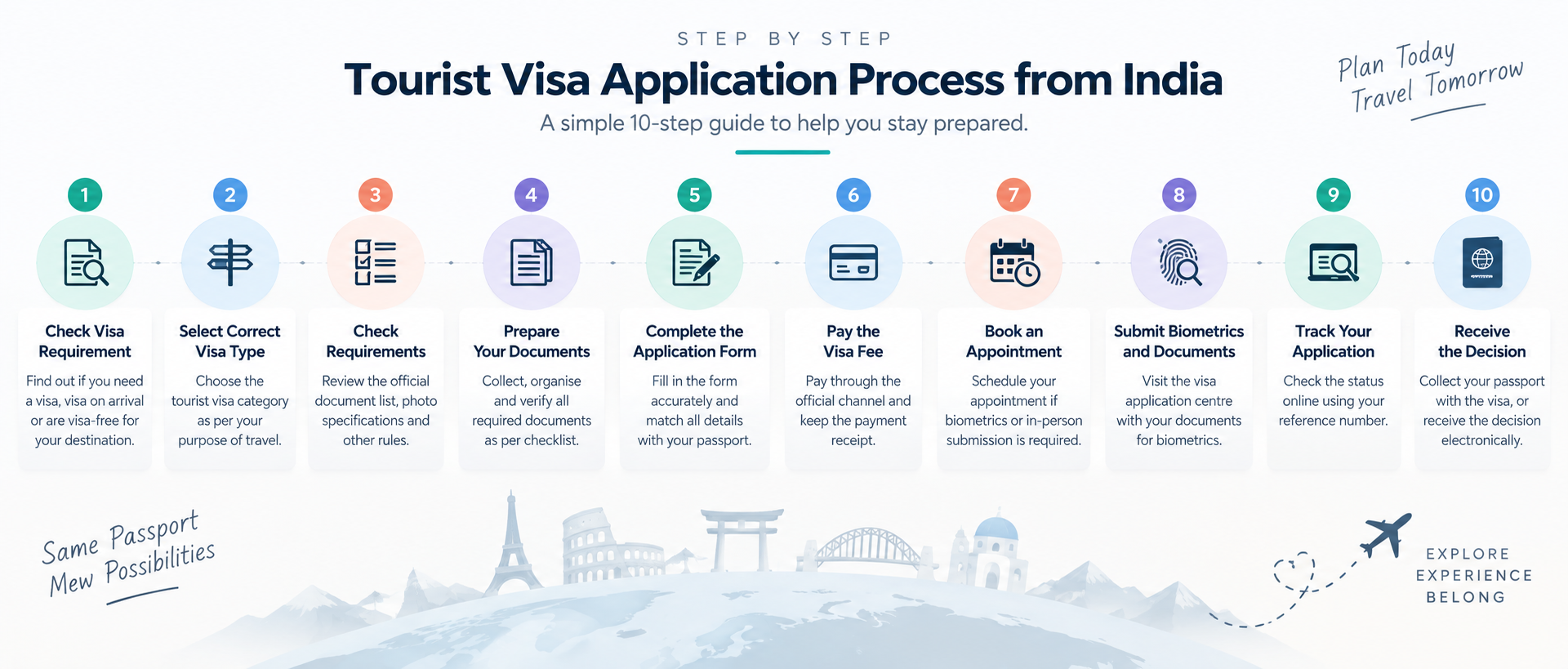
Tourist Visa Application Process from India
The tourist visa process for Indians follows a similar shape everywhere, even though the detail changes by destination.
Step 1: Check Whether You Need a Visa
Start on the destination's official immigration or foreign ministry website, or its embassy or high commission in India. Confirm whether Indian passport holders need a visa in advance, get one on arrival, or are exempt. Note the permitted stay and the purposes it covers.
Step 2: Select the Correct Visa Type
Tourism, business, transit, visiting family and medical travel are usually separate categories with separate document lists. Applying under the wrong category is a common and entirely avoidable reason for refusal. If your trip mixes purposes, read the category definitions carefully before choosing.
Step 3: Check the Official Requirements
Download the official checklist published by the embassy or the government visa portal. Note the photograph specification, the exact bank statement period, whether originals or copies are needed, and whether translations or attestations are required.
Do not treat a blog checklist - including this one - as your final source.
Step 4: Prepare Your Documents
Assemble the file in the order the official checklist specifies.
- Check passport validity and blank pages first
- Get bank statements stamped or authenticated
- Keep photocopies of everything you submit
- Scan the complete file before submission
- Write a clear, factual cover letter
Step 5: Complete the Application Form
Fill it yourself. Match every detail to your passport. Answer refusal-history questions honestly. Sign where required. Save the reference number.
Step 6: Pay the Visa Fee
Pay only through the official channel - the government portal, the embassy's payment link, or the authorised visa application centre. Keep the receipt. Fees are generally non-refundable, including when an application is refused.
Step 7: Book an Appointment if Required
Where biometrics or in-person submission is needed, book the visa appointment through the official system. Appointment availability is itself a planning constraint: in peak season, the earliest slot may be weeks away.
Step 8: Submit Biometrics and Documents
Attend the visa application centre on your appointment date with the appointment confirmation, passport, printed form and complete file. Expect fingerprinting and a digital photograph. Arrive early - centres run to schedule and late arrivals may be turned away.
Step 9: Track Your Application
Most systems offer online visa tracking using a reference number from your receipt. Track the status online rather than calling; the helpline usually has the same information.
Step 10: Receive the Decision
You will be notified to collect your passport, or the decision will arrive electronically. Possible outcomes are visa approval, visa rejection, or a request for additional documents or an interview.
Step 11: Check Your Visa Before Travelling
Do this the day you receive it, not the day you fly. Check:
- Name, passport number and date of birth
- Valid-from and valid-until dates
- Permitted stay - which is not the same as validity
- Single entry or multiple entry
- Territory covered - a Schengen visa may be restricted to specific countries
- Any annotations or conditions
If anything is wrong, contact the issuing authority immediately. Errors are occasionally made, and they are far easier to correct in India than at a foreign airport.
How Long Does a Tourist Visa Take to Process?
Tourist visa processing time from India varies from same-day electronic approvals to several weeks for high-demand embassy visas. Published estimates are indicative, not binding.
The mistake most first-time applicants make is planning around only one of these four stages.
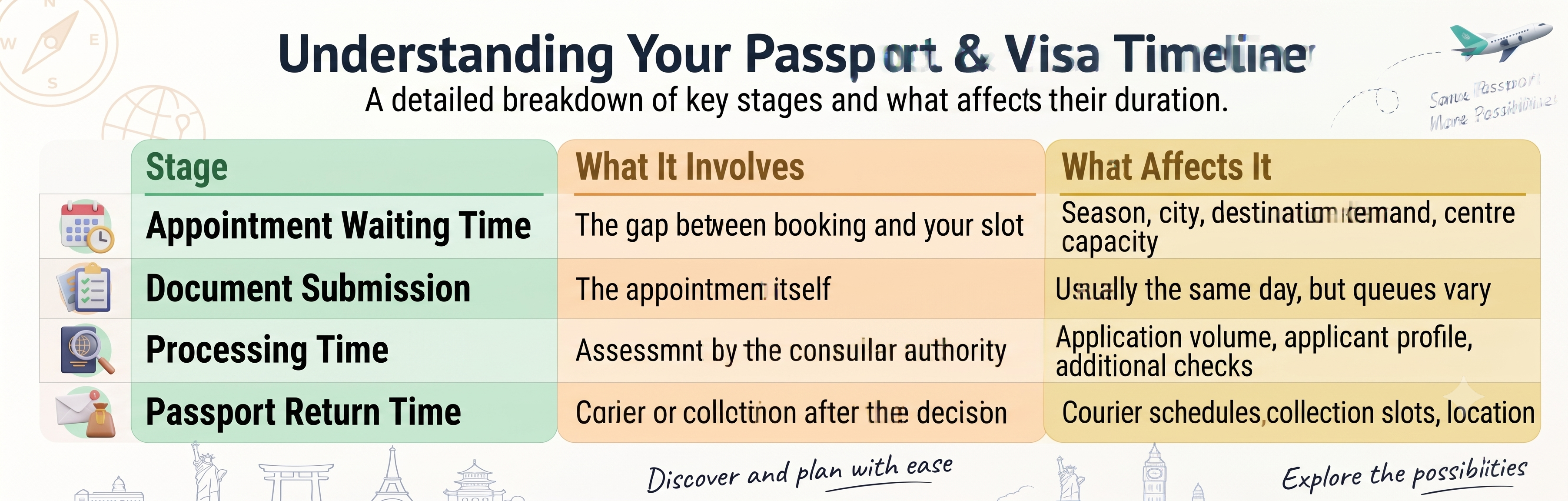
Your real timeline is all four added together. If the next slot is four weeks away and processing takes two weeks, your lead time is six weeks, not two.
Other factors that genuinely matter:
- Peak season lengthens everything. Indian summer holidays, Diwali, Christmas, New Year and the European summer all create surges in both appointment scarcity and processing queues.
- Incomplete applications cause delays. A missing document or an unexplained financial entry triggers a request for more information, which restarts the clock.
- Some applications go for additional checks. Verification calls, administrative processing or referral to a home authority can extend timelines unpredictably. This is not necessarily a sign of a problem.
- Category matters. eVisas are usually faster than sticker visas. Long-validity, multiple-entry visas may take longer than single-entry ones.
Processing times vary by country, season, application volume and applicant circumstances, so check the current published estimate on the official site shortly before you apply - and never build a plan that only works if everything moves quickly.
Tourist Visa Fees for Indians
The headline visa fee is rarely the full cost. Here is what tourist visa fees for Indian passport holders typically include.
Points worth knowing:
- Fees are usually set in foreign currency. The rupee amount you pay depends on the exchange rate on the day, plus your card's forex markup. Two people paying the same official fee weeks apart can pay different amounts.
- Non-refundability is the norm. This is a strong argument for preparing carefully rather than applying speculatively.
- Concessions exist. Many countries charge reduced fees for children, and some waive fees for particular categories. Check the official fee schedule.
- Premium services do not influence the decision. Priority processing may shorten a queue; nothing sold at an application centre affects whether the visa is granted.
This guide deliberately does not list rupee amounts per destination. Fee schedules are revised periodically, and a figure that is accurate today may mislead a reader six months from now. Check the official fee page for your destination on the day you apply.
Travel Insurance for Tourist Visa Applications
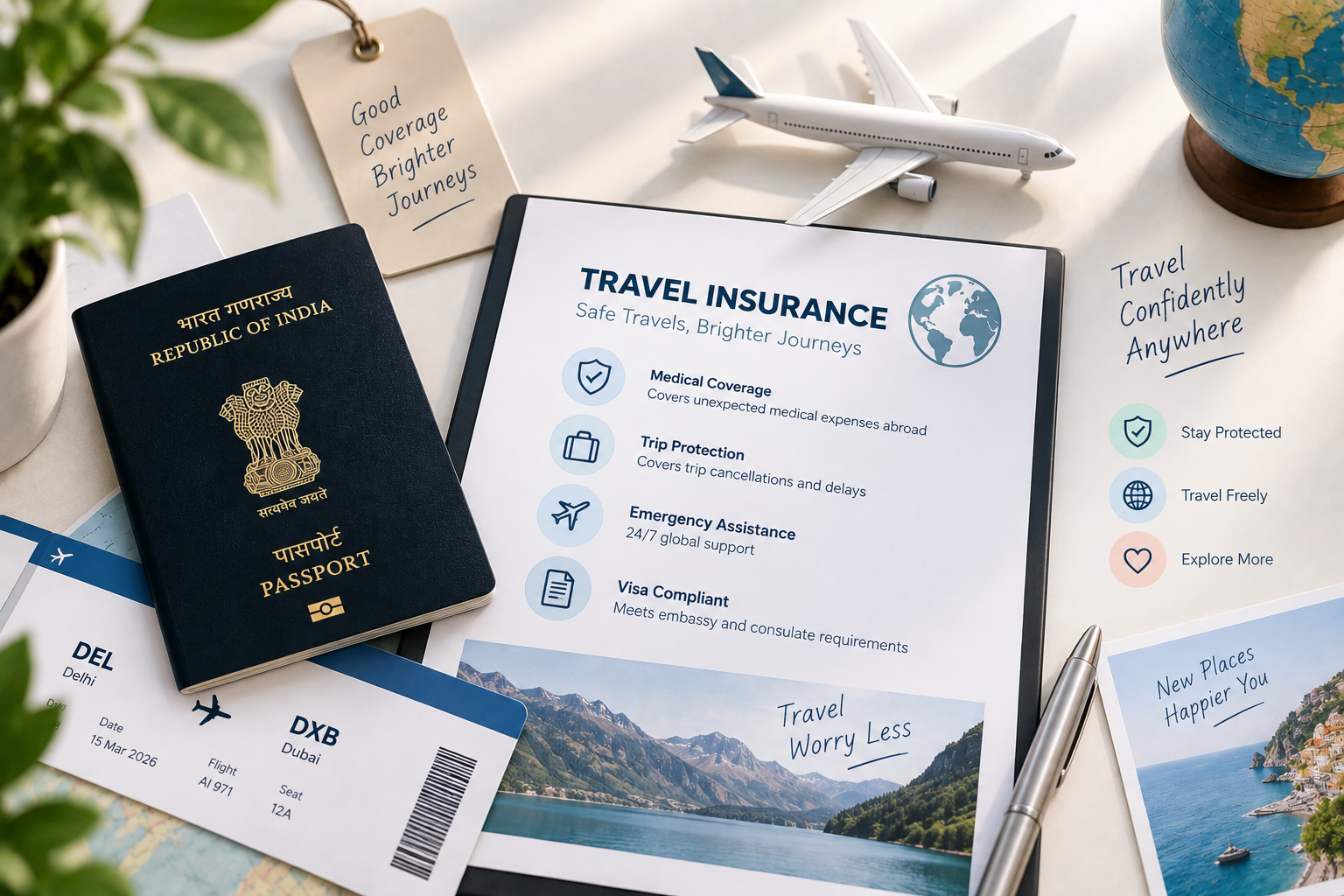
Travel insurance is a short-term policy covering medical and travel-related risks while you are abroad. For some destinations it is a visa requirement. For all destinations it is sensible.
When it may be mandatory
The clearest example is the Schengen Area. Under European Union visa rules, short-stay visa applicants must hold travel medical insurance providing a minimum of €30,000 in cover for emergency medical treatment, emergency hospitalisation and repatriation, valid across all Schengen states for the entire duration of the intended stay. An application with insufficient cover, a policy that does not span the full trip, or an insurer not recognised for Schengen purposes can be refused on that basis alone.
Several other destinations require proof of medical or travel insurance, either at the visa stage or at the border. A few require cover purchased from approved local providers. Requirements vary by destination, so check the official checklist for yours.
What visa-compliant insurance normally covers
- Emergency medical expenses while abroad
- Emergency treatment and in-patient hospitalisation
- Medical repatriation - transport home for medical reasons
- Repatriation of mortal remains
- Destination coverage across the entire territory, not a single country
- Duration of coverage spanning the full trip, including arrival and departure days
Practical guidance
- Buy the policy before submission if it is on the checklist, and include the certificate in the file
- If you extend your trip, extend the policy
- Read the exclusions - pre-existing conditions, adventure activities and age limits are common carve-outs
- Older travellers should buy early; premiums and medical declarations take longer to arrange
- Even where insurance is optional, medical costs in many destinations are high enough that travelling uninsured is a poor risk
For a fuller breakdown, read our guide to international travel insurance requirements for visa approval.
VFS Global, Embassy or Consulate - What Is the Difference?
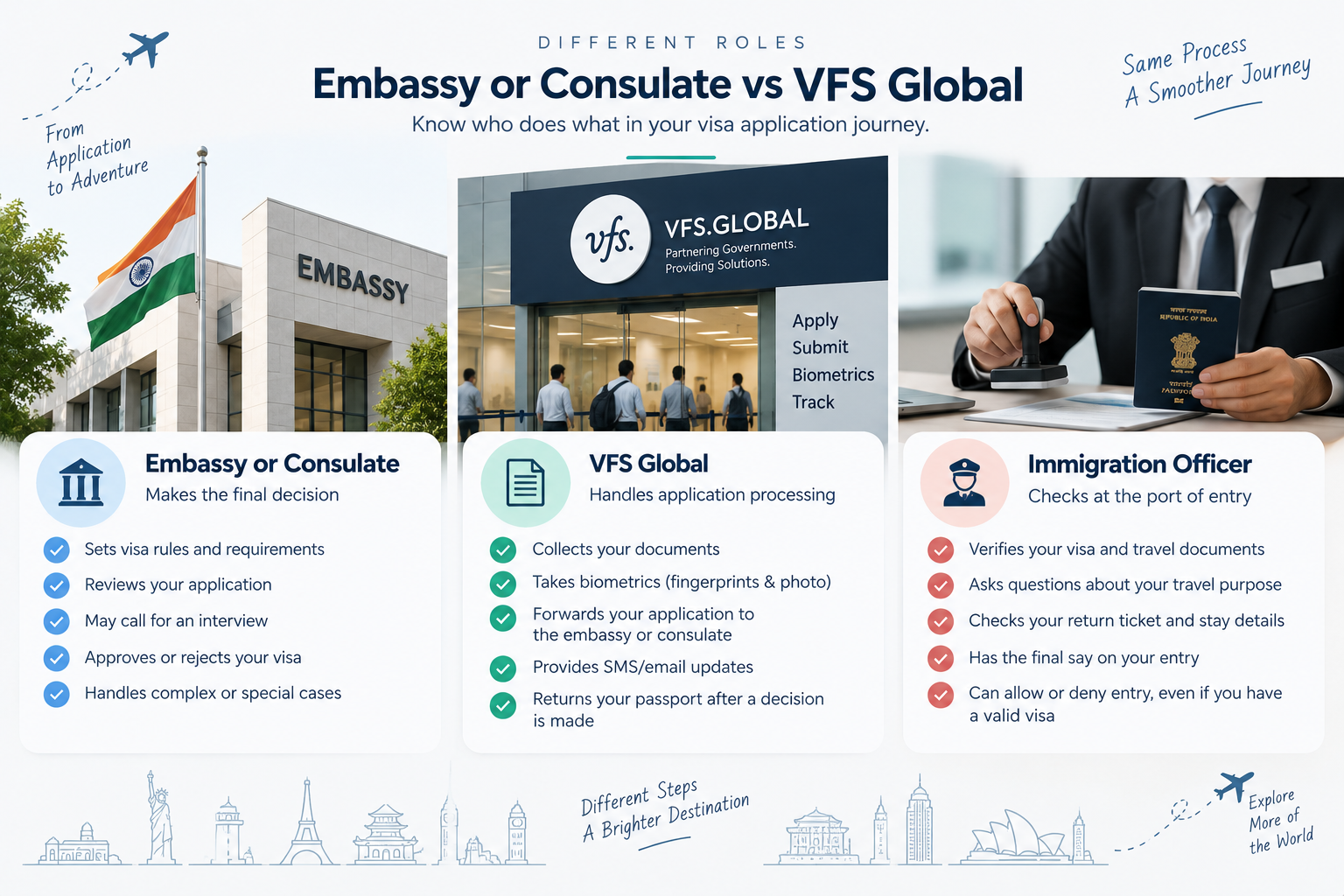
These three are used interchangeably in everyday conversation. They are not the same, and the difference matters when something goes wrong.
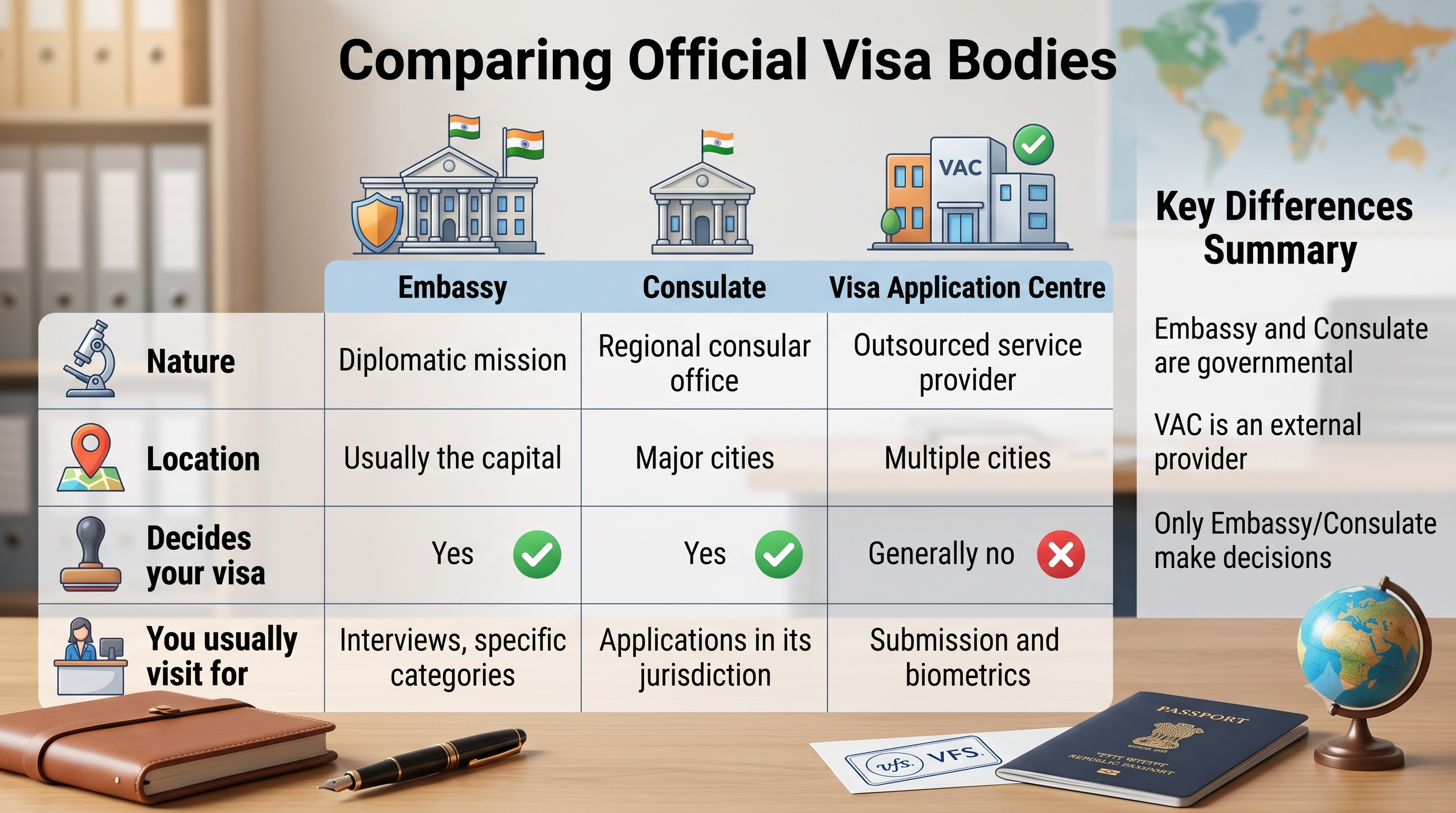
Embassy
A country's principal diplomatic mission, usually located in the capital - New Delhi for most missions in India. It handles diplomatic relations along with consular and visa functions. Its consular officers make visa decisions.
Consulate
A subsidiary office in other major cities, handling visa and consular services for a defined region. Consulates issue visas for applicants within their jurisdiction. Which consulate you apply to is usually determined by your state of residence, not your preference.
VFS Global
An outsourcing partner contracted by governments to operate visa application centres. Staff at these centres accept applications, capture biometrics, collect fees, answer procedural questions and return passports.
The key clarification
VFS Global and similar providers operate application centres on behalf of governments. They generally do not make the visa decision. If your application is refused, it was refused by the country's consular authority. The centre cannot reverse it, and cannot explain the reasoning beyond what the mission has provided.
This also means no service purchased at an application centre improves your chances of approval.
Official-source warning
Fraudulent visa appointment and application websites are common. They typically use domain names closely resembling official ones, rank in paid search results above the genuine site, charge large "service fees" for free or low-cost government services, collect passport data and payment details, and sometimes sell appointment slots that do not exist.
How to protect yourself:
- Reach the visa application centre's website through the destination embassy's official site in India, not through a search advertisement
- Verify you are on the country-specific page - providers run separate portals for each government they serve
- Never pay an appointment fee to an individual or over a messaging app
- Be suspicious of any site guaranteeing approval, guaranteeing an appointment date, or offering to "unlock" slots
- Check the URL character by character before entering passport details
Our VFS Global appointment booking and login guide explains the process and the verification steps in more detail.
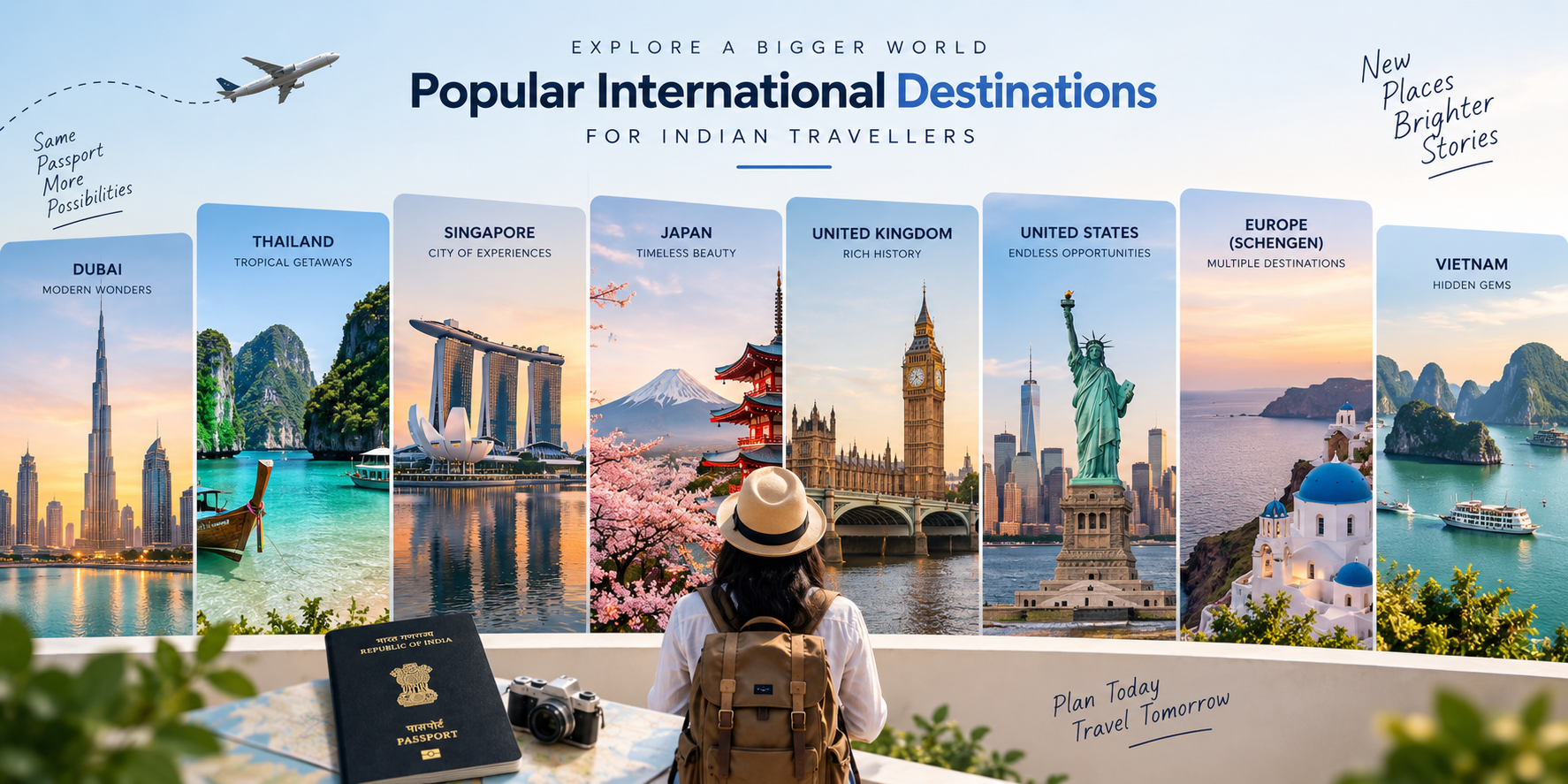
Popular International Destinations for Indian Travellers
This table is an introduction, not a rulebook. Entry routes for Indian passport holders are revised regularly. Read the linked destination guide, then confirm on the official source before applying.
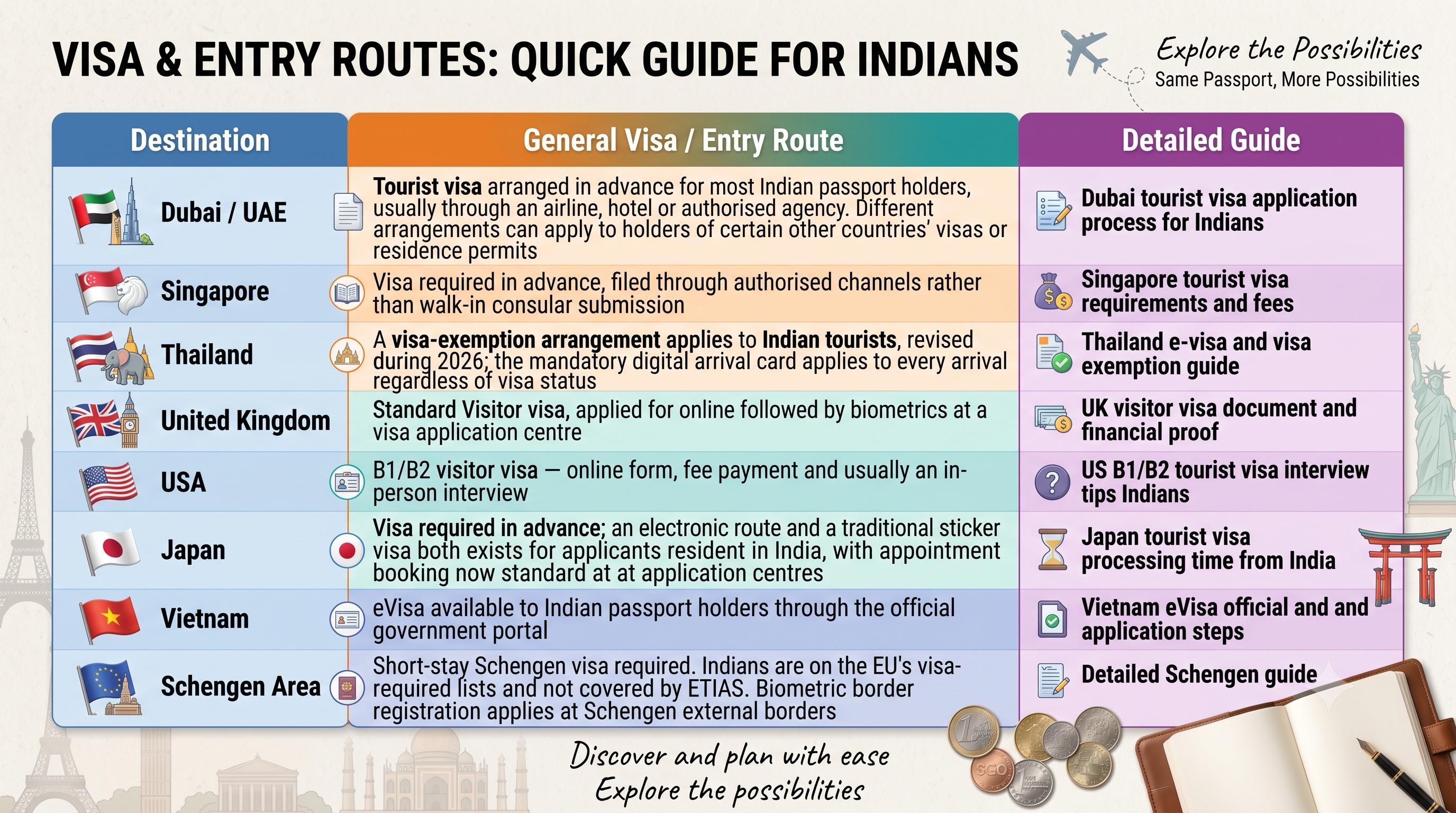
Short notes
Dubai and the UAE remain the highest-volume destination for Indian travellers, largely because the application is normally handled by the airline, hotel or agency arranging the trip rather than requiring an embassy visit.
Singapore keeps documentation comparatively light for most leisure applicants, but permission must still be obtained in advance.
Thailand is the clearest illustration of why this page avoids hard-coding rules. The arrangement for Indian travellers changed more than once during 2026, while the digital arrival card requirement has applied to everyone since 2025.
The United Kingdom assesses genuineness closely. Financial documentation, accommodation, itinerary and ties to India all carry real weight.
The United States uses an interview-based model, with the form, fee and appointment handled through official U.S. Mission India systems. Interview wait times vary significantly by city and season.
Japan has moved steadily towards digital processing for applicants resident in India, alongside the traditional sticker visa.
Vietnam operates a government eVisa portal - and is exactly the category where lookalike commercial websites proliferate.
The Schengen Area is the most document-intensive route for most Indian travellers, and the one with the most moving parts in 2026.
Travellers who want to avoid advance paperwork altogether may also want to read our guide to visa on arrival countries for Indian passport holders.
Tourist Visa Checklist for Indians
A practical, destination-neutral checklist.
□ Valid passport (validity and blank pages checked)
□ Previous passports, where applicable
□ Passport photographs to the exact specification
□ Completed and signed visa application form
□ Flight itinerary or reservation
□ Accommodation proof / hotel booking
□ Bank statements for the required period
□ Income tax returns
□ Salary slips
□ Employment or business proof
□ Leave approval letter
□ Cover letter
□ Travel insurance certificate
□ Copies of previous visas
□ Sponsorship documents, if applicable
□ Invitation letter, if applicable
□ Appointment confirmation
□ Visa fee payment receipt
□ Photocopies and scans of the entire file, kept at home
Note: The actual checklist varies by destination, visa category and applicant profile. Use this as a preparation aid, and the official embassy checklist as your authority.
Tourist Visa Checklist Based on Your Profile
Different profiles are assessed differently. Here is what each should emphasise.
Salaried Employees
Your strength: Verifiable, regular income and a clear reason to return.
Emphasise: Employment letter with designation, joining date, salary and approved leave dates; last three to six salary slips; bank statements showing matching salary credits; ITRs; leave approval covering the exact travel dates.
Watch for: Mismatches between salary slips and bank credits; leave letters that end before your return flight. If you joined recently, include a relieving or experience letter from your previous employer.
Self-Employed / Business Owners
Your strength: Documented business income and ownership ties to India.
Emphasise: Business registration and GST registration; audited or CA-certified financials; two to three years of ITRs; both current and savings account statements; evidence the business continues while you travel.
Watch for: Irregular income is normal in business, but it should be explainable. A short note describing your business, its clients and its seasonality prevents unnecessary questions.
Students
Your strength: Clear institutional ties and a documented reason to return.
Emphasise: Bonafide or enrolment certificate; no-objection certificate covering the travel dates; sponsor's sponsorship letter, financial documents and relationship proof; your own account statements if any; evidence of course continuation or exam schedule.
Watch for: Students rarely have independent finances, and that is expected. What matters is that the sponsorship chain is fully documented.
Sponsored Travellers
Your strength: Someone with demonstrable capacity is funding the trip.
Emphasise: Signed sponsorship letter stating the relationship and exactly what is covered; sponsor's bank statements, ITR and income proof; sponsor's identity and residence documents; relationship evidence; your own documents, however modest.
Watch for: Sponsorship by a non-relative attracts more scrutiny. Some destinations require a prescribed undertaking form rather than a free-form letter.
Families
Your strength: Travelling as a family unit is itself a return-intent signal.
Emphasise: A separate complete application for every traveller including infants; birth certificates for children and marriage certificate for spouses; one primary sponsor's financial documents with the relationship documented for each dependant; a single coherent itinerary and accommodation covering everyone; school leave letters for children travelling in term time.
Watch for: Minors travelling with one parent or with grandparents often need a notarised consent letter from the absent parent or guardian. This is a frequent cause of trouble at both the visa stage and the border.
Retired Travellers
Your strength: Assets, pension income and strong ties to India.
Emphasise: Pension statements or pension payment order; bank statements showing pension credits; ITRs if filed; fixed deposits, property and investment proof where accepted; sponsorship documents if a child is funding the trip; age-appropriate travel insurance.
Watch for: Age limits and premium loadings on travel insurance, and pre-existing condition clauses. Arrange cover early.
Common Tourist Visa Mistakes to Avoid
Most refusals trace back to a small set of avoidable errors. These are the common reasons for tourist visa rejection among Indian applicants.
Choosing the wrong visa category. Tourism, business and family visit categories have different requirements. Choose deliberately.
Providing inconsistent information. Your form, cover letter, bank statements, employment letter and itinerary must agree with one another. Contradictions are noticed and are hard to explain afterwards.
Unexplained large bank deposits. A sudden lump sum shortly before applying is the most common financial red flag. Explain and document it, or apply after the balance has been stable for some months.
Submitting incomplete documents. The most common cause of delay, and entirely self-inflicted. Work from the official checklist.
Incorrect photographs. Dimensions, background, head size, expression, spectacles and head coverings are all specified and enforced.
An expired or insufficiently valid passport. Most destinations require six months' validity beyond departure. Renew well in advance.
Fake or altered documents. Fabricated statements or forged letters can result in refusal, a long-term ban and legal consequences. There is no version of this worth the risk.
An unrealistic itinerary. Six countries in seven days, or a trip that does not match your declared income, invites questions.
An unrealistic itinerary. Six countries in seven days, or a trip that does not match your declared income, invites questions.
Using unofficial visa websites. Only use government portals and the authorised application centre. Verify the URL before entering personal data.
Ignoring transit requirements. A layover in a third country can require its own transit visa, depending on the airport, whether you change terminals and whether you collect baggage. Check every point on your route.
Ignoring travel insurance requirements. Insufficient cover, or a policy that does not span the full trip, can cause refusal on its own for some destinations.
Waiting until the last minute. Appointment scarcity and processing queues are real constraints. Late applications leave no room for a single delay.
Assuming visa approval guarantees entry. It does not - see the next section.
Visa-Free vs Visa on Arrival vs eVisa vs Embassy Visa
Does Getting a Visa Guarantee Entry?
No — and this deserves its own section, because misunderstanding it can end a holiday at the airport.
A visa is permission to travel to a country's border and request entry. It is not, by itself, permission to enter.
At border control, the immigration officer conducts a separate assessment. They may:
- Ask the purpose and duration of your visit
- Ask where you are staying, and ask to see the booking
- Ask to see your return ticket
- Ask about your funds, and occasionally ask to see them
- Ask about your employment and ties to India
- Inspect your baggage
- Check your immigration and travel history
- Capture your biometrics, where that system applies
Entry can be refused even with a valid visa - for example where the stated purpose differs from the visa category, where documents cannot be produced, where previous immigration rules were breached, or where the officer is not satisfied the visit is genuine.
What this means in practice:
- Carry your supporting documents in cabin baggage, not in checked luggage -hotel bookings, return ticket, insurance certificate, invitation or sponsorship letter, and some funds
- Answer questions briefly, accurately and consistently with your visa application
- Complete any arrival card or digital registration before you land
- Know your permitted stay and respect it; overstaying has lasting consequences for future applications

How Early Should Indians Apply for a Tourist Visa?
There is no single number of days that works for every destination. But there is a reliable way to work out your own.
Work backwards from four things, not one:
Your travel date
The earliest available appointment slot at your visa application centre
The current published processing time for your destination
Passport return time
Add them together, then add a buffer.
General planning guidance:
- For embassy and VFS visas, start researching two to three months before travel and submit as early as the rules permit
- Check the earliest permitted submission date. Many countries will not accept applications more than a fixed period before travel - often around six months for short-stay visas. Applying too early can be as much of a problem as applying too late.
- For eVisas, apply at least a few weeks ahead even where approval is normally quick, so there is room to correct an error
- For visa-free and visa-on-arrival destinations, no visa lead time is needed - but check passport validity, arrival card requirements and insurance well in advance
- In peak season, add substantial buffer to every estimate
- If you need more than one visa for a multi-country trip, sequence them carefully; your passport may be held during processing, which blocks parallel applications
One firm recommendation: avoid paying for non-refundable flights and hotels before your visa is issued, unless the destination genuinely requires confirmed bookings and you have accepted that risk knowingly.