VFS Global vs Embassy: Difference, Process & Fees Guide
VFS Global vs Embassy: Difference, Visa Application Process, Fees & Complete Guide
Imagine you've filled out your visa form, gathered your documents, and reached the application centre for your appointment. As you hand over your passport, a thought crosses your mind: "Wait - is this VFS Global or the embassy? Who is actually deciding whether I get this visa?"
If you've ever asked yourself that question, you're not alone. This confusion is one of the most common ones Indian travellers face when applying for an international visa. This guide breaks down the real difference between VFS Global and Embassy, how the visa application process actually works, what happens at your appointment, how fees are structured, and how to track your application - so you walk into your visa journey with clarity instead of guesswork.
What Is VFS Global?
VFS Global is a private outsourcing company that manages the administrative side of visa applications on behalf of governments. It is not a government body, an embassy, or a consulate - it is a service provider that governments hire to handle the front-end, paperwork-heavy parts of the visa process.
Many governments don't have the staff or physical space to personally receive every visa application, collect biometrics, and manage document verification in every city. So they contract companies like VFS Global to run dedicated visa application centres on their behalf.
What does VFS Global do?
At a typical VFS Global centre, applicants can generally expect to:
- Submit their visa application form and supporting documents
- Have their biometrics (fingerprints and photograph) captured, where required
- Pay the applicable visa and service fees
- Receive guidance on the checklist for their specific visa category
- Track the status of their submitted application
- Use optional paid services such as courier return of the passport, SMS updates, or a premium lounge, where offered
What VFS Global does NOT do
This is the part most applicants misunderstand. VFS Global does not, as a general rule:
- Interview applicants for visa eligibility
- Assess or judge the merits of an application
- Approve or reject a visa
- Set visa policy or eligibility rules
- Decide the biometric or document requirements - these come from the relevant government
VFS Global operates in over 140 countries on behalf of client governments, embassies, and diplomatic missions worldwide, acting purely as an administrative link between the applicant and the decision-making authority.
What Is an Embassy?
An embassy is the official diplomatic mission of one country located in another country, usually in its capital city. It represents the sending country's government and is responsible for managing the overall diplomatic relationship between the two nations.
Embassies handle far more than visas. Their core responsibilities typically include:
- Managing political, economic, and diplomatic relations with the host country
- Representing their government's interests abroad
- Assisting their own citizens travelling or living in the host country
- Overseeing the consular section, which deals with visa applications, passport services, and document attestation
Embassy visa application process
When you hear the term embassy visa application process, it usually refers to the fact that the visa decision is ultimately taken by the consular officers attached to the embassy - even if the paperwork was physically submitted at a VFS Global centre. The embassy's consular section reviews the application, checks eligibility against immigration rules, and issues the final decision, which is then communicated back through the application centre or directly to the applicant, depending on the country's process.
What Is a Consulate?
A consulate is a smaller diplomatic office that represents a country's interests in a city other than the host country's capital, and it typically focuses on service-oriented work rather than broader political diplomacy.
Key points about consulates:
- They are usually located in major cities away from the capital (for example, a country may have its embassy in New Delhi and a consulate in Mumbai or Chennai)
- They are headed by a consul or consul general, rather than an ambassador
- Their day-to-day work leans heavily toward visa processing, passport renewals, document attestation, and emergency assistance for citizens
- Applicants dealing with a consulate rather than an embassy typically live in that consulate's designated jurisdiction
For Indian applicants, this matters because your visa jurisdiction is often decided by your city or state of residence - you may need to apply through the consulate that covers your region rather than the embassy in the capital.
Embassy vs Consulate vs VFS Global: What Is the Difference?
Here's a side-by-side look at how these three entities generally differ. Exact responsibilities can vary by country and visa programme, so treat this as a general framework rather than a fixed rule.
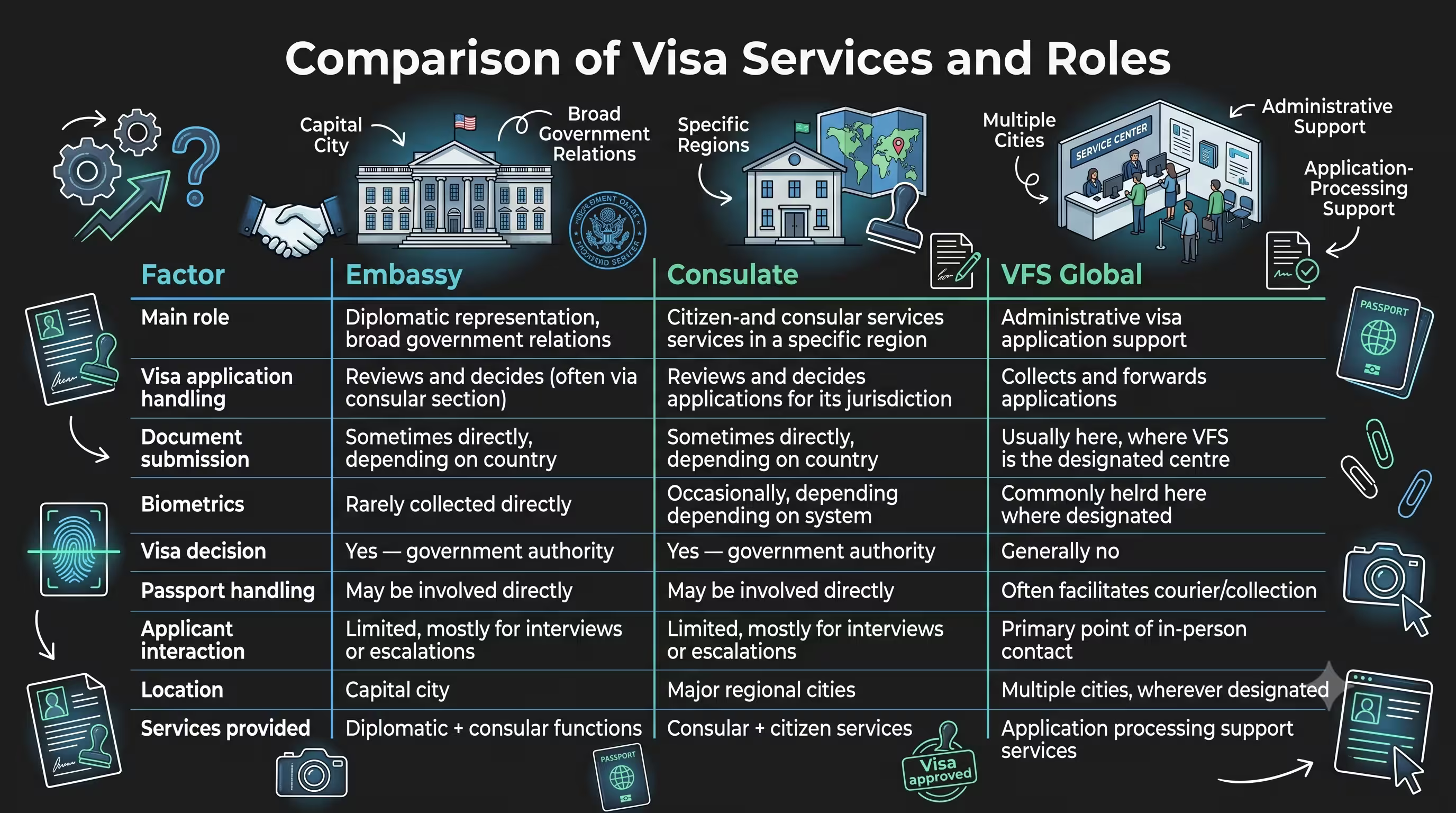
VFS Global vs Embassy: What Is the Difference?
This is the question most applicants are really trying to answer, so let's be direct about it.
The core difference between VFS Global and an embassy is this: VFS Global handles the administrative front-end of your application, while the embassy (through its consular section) is generally the authority that makes the actual visa decision.
Here's how responsibilities are typically divided:
- Who accepts documents: Usually VFS Global, at the designated visa application centre
- Who collects biometrics: Usually VFS Global, where biometric collection is outsourced
- Who processes the application: VFS Global forwards the collected application and documents to the relevant embassy or consulate
- Who makes the visa decision: Generally the embassy, consulate, or government immigration authority - not VFS Global
- Who communicates the final decision: This varies; some governments communicate directly, while others route the decision back through VFS Global for passport return
- What happens to the passport: It is usually submitted at the VFS centre, forwarded for processing, and then returned via the centre (in person or courier) once a decision is made
Don't Assume: VFS Global handling your documents does not automatically mean that VFS Global is making the visa decision. The responsible government authority generally assesses the application and decides the outcome.
Does VFS Global Approve or Reject Visas?
Generally, no. VFS Global does not make the final visa decision. It provides application support services such as document collection, biometrics, and passport logistics, while the relevant embassy, consulate, or government authority reviews the application and decides the outcome.
That said, exact arrangements can vary by country and visa category. Some governments run their own in-house application process without VFS Global, and some outsourcing partners other than VFS Global handle certain countries' visas. Always check the official visa authority's website for your specific destination to confirm who is responsible at each stage.
VFS Global Visa Application Process: Step by Step
Here is what the VFS Global visa application process generally looks like from start to finish. Depending on the destination country, some steps may differ slightly.
Step 1: Identify the Correct Visa
Confirm the visa category that matches your purpose of travel - tourist, business, student, work, or transit. Applying under the wrong category is one of the most common and avoidable mistakes.
Step 2: Check Official Visa Requirements
Visit the official embassy, consulate, or immigration website for your destination country to confirm current eligibility rules, validity requirements, and the exact document checklist for your visa category.
Step 3: Complete the Visa Application
Fill out the official visa application form, either online or offline depending on the country's system. Double-check personal details, travel dates, and passport information for accuracy.
Step 4: Prepare Your Documents
Gather the required documents based on the official checklist - this typically includes your passport, photographs, and supporting evidence relevant to your visa category.
Step 5: Book a VFS Global Appointment
If the destination country uses VFS Global, book your appointment through the official VFS Global portal for that country. Appointment slots depend on availability set by the relevant government authority, not VFS Global itself.
Step 6: Attend the Appointment
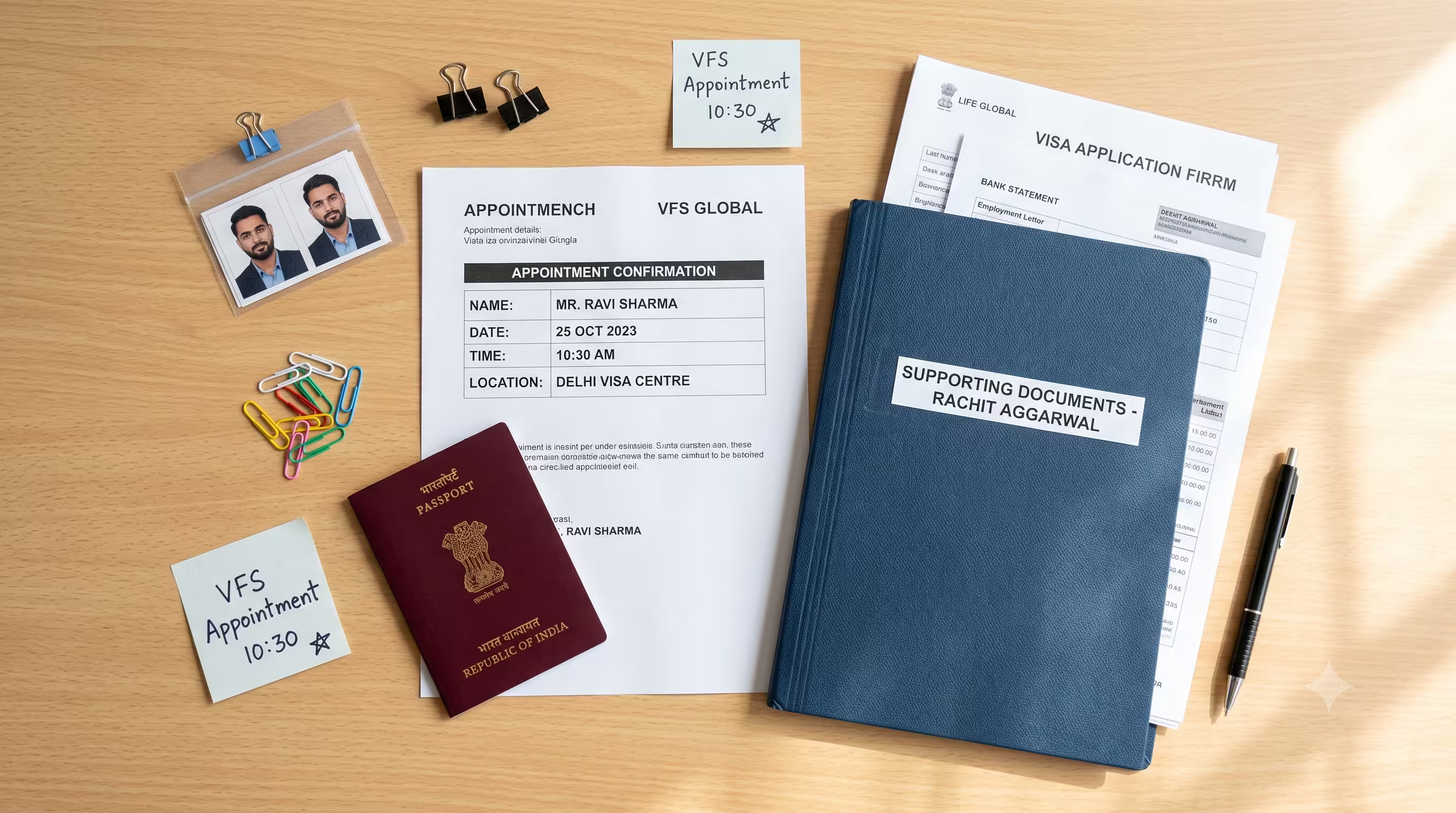
Arrive at the visa application centre on time, with all original and photocopied documents, your appointment confirmation, and your passport.
Step 7: Submit Documents and Biometrics
Your documents are verified, your biometrics (fingerprints and photograph) are captured where required, and your fees are collected.
Step 8: Application Is Forwarded to the Relevant Authority
VFS Global forwards your application, documents, and biometric data to the embassy, consulate, or immigration authority responsible for the decision.
Step 9: Visa Decision
The relevant government authority reviews your application and takes a decision. Processing times vary significantly by country, visa category, and season, so avoid relying on unofficial timelines.
Step 10: Passport Return or Collection
Once a decision has been made, your passport is returned to you - either through courier, in-person collection at the VFS centre, or another method specified by the destination country.
What Happens at a VFS Global Appointment?
A typical VFS Global appointment generally includes:
- Check-in: Your appointment confirmation and passport are verified at entry
- Document submission: Your application form and supporting documents are checked against the official checklist
- Application verification: Staff confirm that your form matches your documents and passport details
- Biometrics: Fingerprints are captured where required by the destination country
- Photograph: A photograph may be taken on-site, depending on the visa programme
- Passport submission: Your passport is collected for forwarding to the relevant authority
- Additional services: Optional paid services such as courier return, SMS alerts, or form-filling assistance may be available
- Receipt or reference number: You'll receive an acknowledgment slip or reference number to track your application later
What Is a VFS Global Biometric Appointment?
A VFS Global biometric appointment is the part of the visa process where your fingerprints and photograph are digitally captured for identity verification, as required by many visa programmes.
Why biometrics are collected
Governments use biometric data to verify identity, cross-check against security databases, and reduce identity fraud in the visa system.
What to carry
- Your original passport
- Appointment confirmation
- Any documents specifically required for the biometric step, as per the official checklist
What happens during the appointment
Fingerprints are typically scanned electronically, and a passport-style photograph may be taken on-site if a digital photograph wasn't already submitted with your application.
What happens after biometrics
Your biometric data is stored and linked to your application before being forwarded, along with your documents, to the relevant embassy or consulate for review.
Important Note: Biometric requirements - including which fingers are scanned, validity period of previously submitted biometrics, and exemptions for children or seniors - vary by country. Always confirm the current rule for your specific visa category on the official website.
What Documents Do You Need for a VFS Global Appointment?
Document requirements depend heavily on the destination country, visa type, applicant profile, and purpose of travel. There is no single universal checklist that applies to every visa.
That said, a general starting checklist for most tourist visa applications often includes:
- Valid passport (with required minimum validity and blank pages)
- Completed visa application form
- Appointment confirmation
- Passport-size photographs meeting the destination country's specifications
- Proof of financial means (bank statements, income proof, etc.)
- Travel itinerary or flight reservation
- Accommodation proof (hotel booking or invitation letter)
- Employment or education documents, where applicable
- Travel insurance, where required (mandatory for Schengen visas, for example)
- Any additional destination-specific documents listed in the official checklist
Applicant Checklist: Before your appointment, always cross-check your documents against the current official checklist published by the embassy, consulate, or VFS Global page for your specific country and visa category - not a generic list from a blog or forum.
VFS Global Fees: How Much Does It Cost?
One of the most common points of confusion is the difference between two separate charges:
- Government visa fee: This is the fee set by the destination country's government or immigration authority for processing your visa application. It goes toward the visa itself, not VFS Global's services.
- VFS Global service fee: This is a separate charge for the administrative services VFS Global provides - application handling, biometric collection, and centre operations.
On top of these two core charges, you may also encounter optional charges such as:
- Courier charges for passport return
- SMS status update services
- Premium lounge or priority services, where offered
- Form-filling assistance, where offered
Real Traveller Scenario: Two friends applying for the same visa category can end up paying different combined totals if one opts for courier return and premium services while the other doesn't - but the core government visa fee stays the same for both.
Important Note: VFS Global fees and government visa fees vary significantly by country, visa category, application centre, and currency exchange rates, and they change over time. Always verify the exact, current fee breakdown on the official VFS Global page or embassy website for your specific visa before applying - do not rely on a fixed number from any third-party article.
VFS Global Visa Tracking: How to Track Your Application
After submitting your application, you'll usually receive an application or reference number. Here's how tracking generally works.
Where to track
Most countries provide a tracking option on the official VFS Global website for that specific country, using your reference number and passport number or date of birth.
What status messages usually mean
Common status updates include stages such as "application received," "forwarded to embassy/consulate," "under process," and "ready for collection" - though the exact wording and number of stages vary by country.
An important caveat
Quick Answer: Tracking your application shows where it currently sits in the process - it does not mean a visa decision has been made, and it does not indicate whether the outcome will be positive.
Do not assume that a status update like "forwarded to embassy" or "under review" implies your visa is close to approval. The relevant authority may still be assessing the case, and processing timelines are not guaranteed or fixed.
Can You Apply Directly at an Embassy Instead of VFS Global?
The honest answer is: it depends on the country, the visa category, and the current government instructions.
Here's the nuance:
- Some visa systems mandate that all applications go through an external application centre such as VFS Global - direct submission isn't an option.
- Some countries allow direct submission to the embassy or consulate for specific visa categories, such as diplomatic, official, or certain long-stay visas.
- Some countries use a different outsourcing partner altogether, not VFS Global.
- Some visa categories have unique submission arrangements that differ from the standard tourist or business visa route.
VFS Global or Embassy At a Glance: The correct starting point isn't "can I choose between VFS and the embassy" - it's "what does the relevant government authority currently require for my specific visa category and location?" This information is published on the official embassy, consulate, or immigration website for your destination.
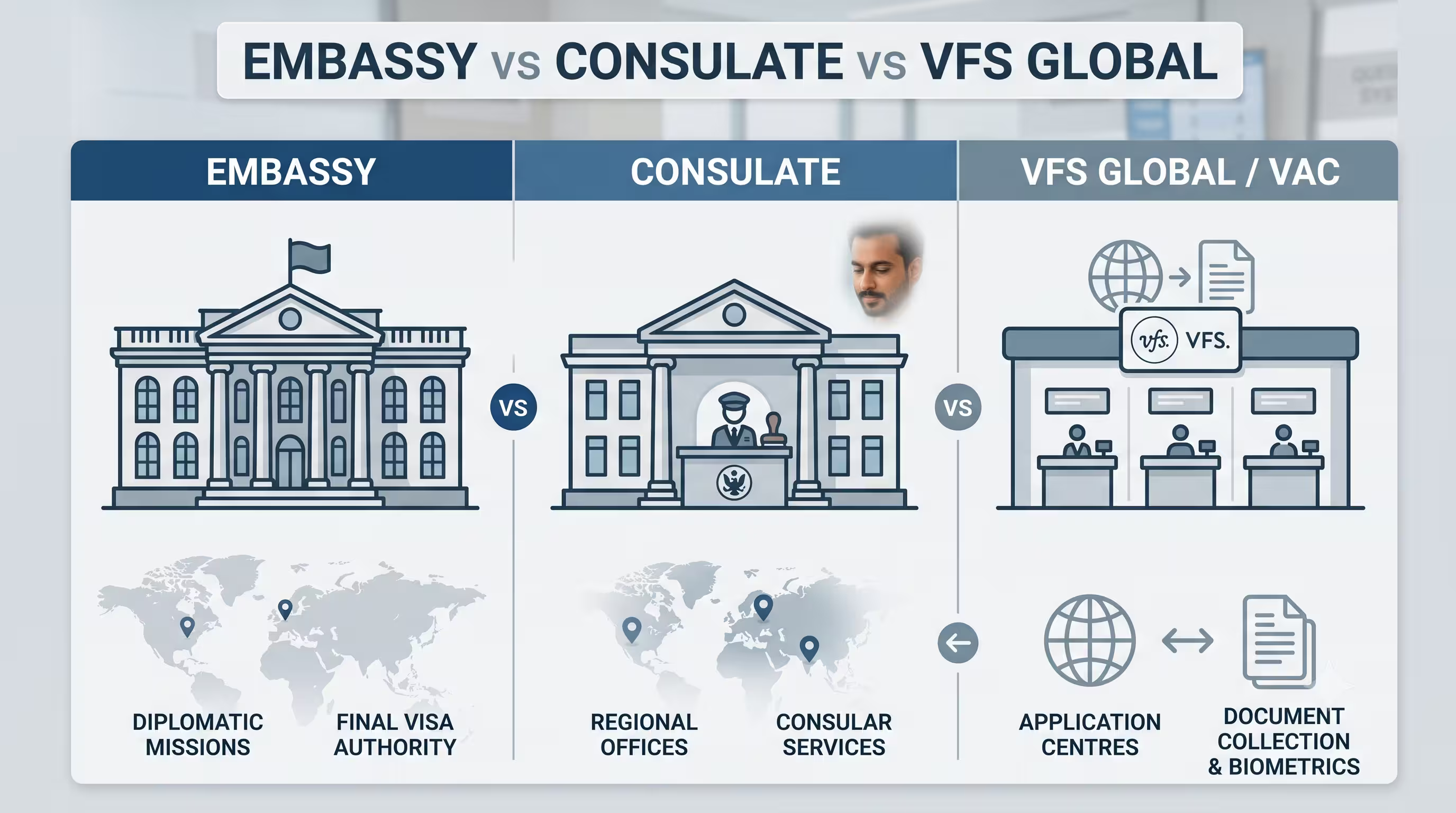
VFS Global vs Embassy: Which One Is Better?
There isn't a universal answer here, because VFS Global and the embassy aren't really competing options - they usually play different roles in the same process.
VFS Global tends to be the practical, and often the only, route when:
- It is the officially designated application centre for your destination country
- Your visa category requires biometric collection
- Document submission is centralised there for efficiency
- You want access to tracking, courier, or other add-on services
Direct embassy or consulate submission may apply when:
- The relevant authority specifically permits or requires direct submission for your visa category
- Government instructions designate a different process for your situation
- You fall under an exemption category (such as certain family-of-diplomat or official visa cases)
The real question to ask is: "Which application route does the relevant government authority require for my specific visa?" - and the answer is always on the official website, not in a general comparison article.
Common Mistakes Applicants Make at VFS Global
Booking the wrong appointment - selecting the incorrect visa category or centre location
Choosing the wrong visa category - applying as a tourist when the purpose of travel is different
Missing required documents - arriving without a document listed on the official checklist
Using outdated checklists - relying on old blog posts or forum threads instead of the current official list
Confusing VFS service fees with visa fees - assuming one payment covers everything
Arriving late - many centres have strict appointment windows
Ignoring biometric requirements - not knowing biometrics are mandatory for a particular visa category
Providing inconsistent information - mismatched details between the form, documents, and passport
Not checking passport validity - many countries require a minimum validity period beyond the travel dates
Relying on unofficial websites - booking appointments or paying fees through third-party sites instead of the official portal
Assuming VFS decides the visa - expecting an outcome or explanation from VFS staff, when the decision sits with the embassy or consulate
Ignoring country-specific instructions - applying general "VFS process" knowledge to a country with a different set of rules
VFS Global vs Embassy
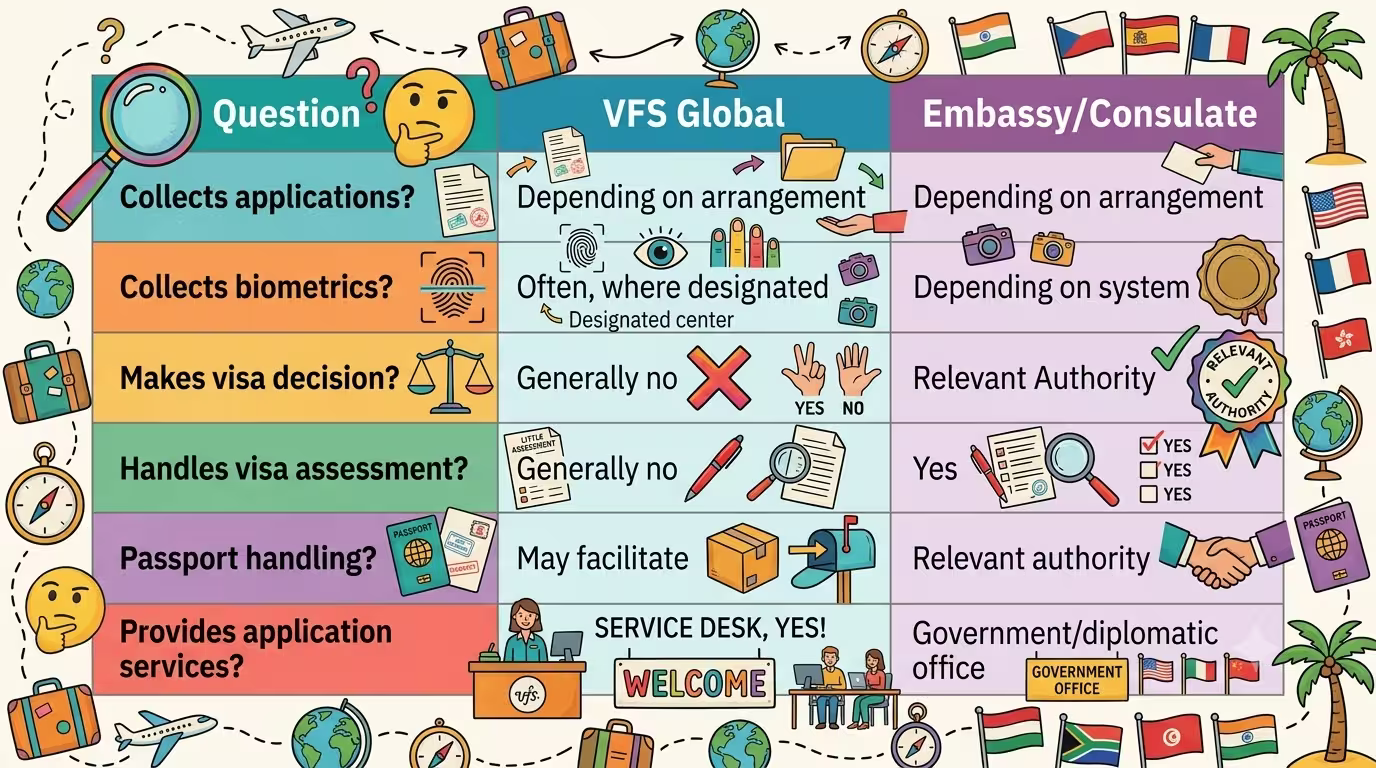
Exact responsibilities vary by visa programme and destination country - always confirm the current process for your specific application on the official website.