Benefits of Travel Insurance You Need to Know

Benefits of Travel Insurance You Need to Know
If you've ever booked an international trip and then quickly ticked "travel insurance" off your checklist without really reading what it does, you're not alone. Most travellers only think seriously about their policy the moment something goes wrong - a delayed flight, a missing suitcase, or worse, a medical emergency in a country where you don't speak the language and don't know a single hospital.
Understanding the real travel insurance benefits before you fly can save you from financial stress, wasted time, and unnecessary panic abroad. This guide breaks down what travel insurance actually covers, when it's required for a visa, what it typically excludes, and how to choose a policy that actually fits your trip - written specifically with Indian international travellers in mind.
Quick takeaway: Travel insurance isn't one-size-fits-all. Two plans that both say "medical coverage" can differ enormously in their limits, exclusions and claim process. Read the policy wording, not just the marketing page.
What Is Travel Insurance and How Does It Work?
Travel insurance is a policy designed to provide financial protection against eligible unexpected events during a trip, such as medical emergencies, trip cancellations, baggage problems and travel disruptions.
Coverage generally begins either on the date specified in the policy or from the moment you leave your home country, depending on the plan you choose - so it's worth confirming the exact start date and time before you travel.
A typical policy may include:
- Emergency medical treatment and hospitalisation abroad
- Emergency evacuation and repatriation
- Trip cancellation or interruption
- Lost, delayed or damaged baggage
- Personal accident cover
- 24/7 travel assistance
Policies differ from insurer to insurer, and even between plans from the same insurer, because each one sets its own coverage limits, deductibles, waiting periods and exclusions. This is why reading the policy wording - not just the brochure - matters. A plan that looks similar to another on the surface can behave very differently when you actually need to file a claim.
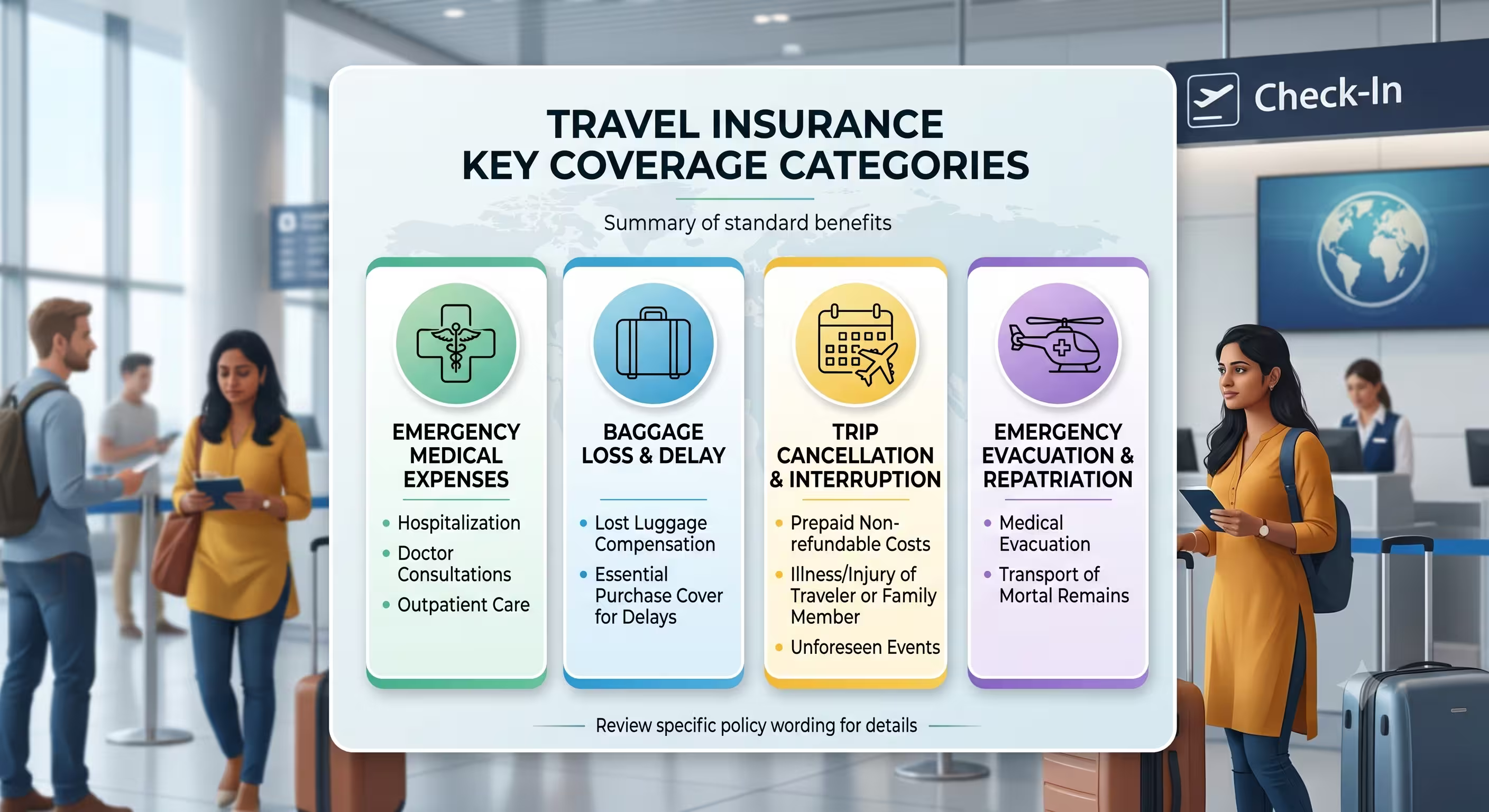
10 Key Benefits of Travel Insurance You Should Know
Understanding the benefits of travel insurance in detail helps you see why it's worth building into your travel budget, not treating as an afterthought.
1. Protection Against Medical Emergencies Abroad
Falling ill or getting injured overseas can be far more expensive than at home, especially in countries like the USA where hospital charges are notoriously high. Many travel insurance plans offer emergency medical coverage that may help pay for doctor visits, hospitalisation, medication and related treatment, subject to the policy's limits and exclusions.
Real traveller scenario: A visitor spraining an ankle on a hiking trail in Switzerland may face a hospital bill running into hundreds of euros just for an X-ray and consultation. Depending on the plan, eligible costs like this may be reimbursed or paid directly by the insurer's assistance network.
Policy Check: Confirm whether the plan pays hospitals directly (cashless) or only reimburses you after you've paid and submitted claims.
2. Coverage for Trip Cancellation
Life doesn't always cooperate with travel plans. A sudden illness, a family emergency, or an unexpected event back home can force you to cancel a trip you've already paid for. Trip cancellation coverage may help recover certain non-refundable costs, depending on the reason for cancellation and the policy's terms.
Don't Assume: Not every reason for cancellation is covered. Most policies list specific, insurer-defined reasons - changing your mind or general anxiety about traveling typically isn't one of them.
3. Protection Against Flight Delays and Missed Connections
Flight delays and missed connections can throw off an entire itinerary, especially on international routes with tight layovers. Some travel insurance plans offer flight delay insurance that may cover reasonable expenses like meals or an overnight stay if a delay crosses a specified threshold, and may extend to help with rebooking a missed connecting flight.
Real traveller scenario: Imagine your flight from Delhi to Frankfurt is delayed by six hours, causing you to miss your connection to Amsterdam. Depending on your policy, eligible costs for the unplanned overnight stay may be covered.
4. Coverage for Lost or Delayed Baggage
Airlines lose or delay bags more often than most travellers realise. Baggage delay coverage and lost baggage insurance may help offset the cost of essentials you need to buy while you wait, or compensate you if your bag is permanently lost, subject to the policy's per-item and total limits.
Imagine landing in Europe after a 10-hour flight, only to discover that your checked bag is still sitting at your departure airport. Travel insurance cannot magically teleport your suitcase - but depending on the policy, it may help cover eligible expenses caused by the baggage delay.
5. Protection Against Lost Passport and Travel Documents
Losing your passport abroad is one of the most stressful things that can happen on a trip. Passport loss coverage under some plans may help with costs related to obtaining an emergency travel document or replacement passport, and travel assistance services may guide you through contacting the nearest Indian embassy or consulate.
6. Emergency Evacuation and Repatriation
In a serious medical emergency, you may need to be moved to a better-equipped hospital or flown back to India for treatment. Emergency evacuation and medical repatriation coverage - often carrying some of the highest limits in a policy - may help fund this, which is one reason this figure matters more than the headline "medical coverage" number when comparing plans.
7. Personal Accident Protection
Personal accident coverage typically provides a lump-sum benefit in the event of accidental death or permanent disability during the covered trip. This is a distinct benefit from medical expense coverage, and it's worth checking how the sum insured is calculated for your chosen plan.
8. Financial Protection Against Covered Travel Disruptions
Beyond cancellations and delays, many plans bundle broader trip interruption and travel disruption benefits - for example, if you have to cut a trip short for a covered reason, or if a natural event disrupts your onward travel. Coverage limits and specific triggers vary widely, so this is a section worth reading closely rather than assuming.
9. 24/7 Emergency Assistance
Most reputable insurers provide a round-the-clock assistance helpline. This service can help coordinate everything from finding a nearby English-speaking doctor to arranging cashless hospital admission or liaising with airlines, which can be invaluable when you're dealing with an unfamiliar country and, often, a language barrier.
10. Peace of Mind During International Travel
It's easy to underrate this one, but knowing that a support system exists if something goes wrong changes how you experience a trip. Financial protection aside, travel insurance means you're not entirely on your own if plans fall apart mid-journey.
Why Is Travel Insurance Important for International Travel?
International trips carry financial risks that many travellers don't fully anticipate until they're standing in a foreign hospital or airport, insurance-less and out of options.
Some of the most common risk areas include:
- Medical treatment abroad, where costs can be far higher than in India and your domestic health insurance typically doesn't apply overseas
- Emergency hospitalisation, which can involve daily charges that add up quickly in high-cost destinations
- Flight disruption, from delays to cancellations, which can cascade into missed hotel check-ins and tours
- Lost baggage, forcing travellers to buy replacement clothing, medication or essentials
- Travel document problems, such as a stolen passport in an unfamiliar city
- Emergency evacuation, needed for serious medical situations where local facilities aren't adequate
Because these risks are financial as much as logistical, travel insurance functions less like a formality and more like a safety net that determines whether a bad moment on a trip stays a bad moment - or turns into a financial setback that follows you home.
What Does Travel Insurance Cover?
Coverage varies significantly by insurer and plan. The table below outlines commonly available coverage types - always confirm exact limits and conditions in your specific policy document.
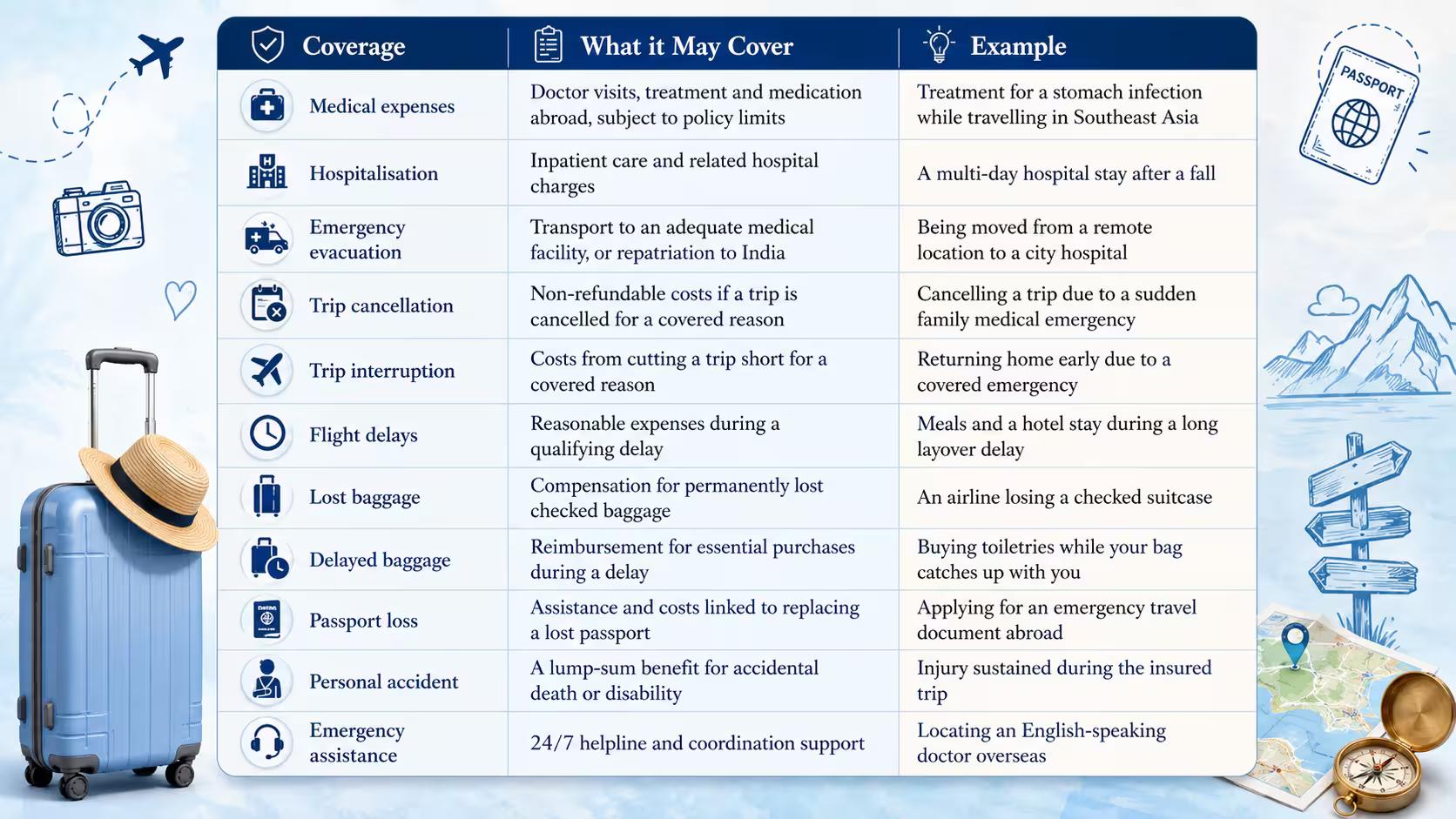
Before You Buy checklist item: Ask your insurer (or read the policy wording) for the exact rupee or foreign-currency limit for each of these categories - "covered" without a number attached tells you very little.
What Is Usually Not Covered by Travel Insurance?
This section matters as much as the benefits themselves, because assuming a policy covers everything is one of the most common - and costly - traveller mistakes.
Depending on the policy, exclusions commonly include:
- Certain pre-existing medical conditions, unless specifically declared and covered
- Travelling against medical advice
- Loss of unattended baggage or valuables
- Certain adventure or high-risk activities, unless an add-on is purchased
- Incidents linked to alcohol or intoxication, where excluded by the insurer
- Incorrect or incomplete documentation submitted with a claim
- Travel to destinations excluded by the policy (for example, regions under an official travel advisory)
- Claims that exceed the specific coverage limits or sub-limits in the plan
- Any event explicitly listed as excluded in the policy wording
Don't Assume: A plan advertising "comprehensive coverage" still has an exclusions page. Read it before you travel, not after you need to make a claim.
Types of Travel Insurance Plans
Different trips call for different structures of cover:
- Single-trip travel insurance - covers one specific trip, ideal for occasional travellers
- Multi-trip travel insurance - covers multiple trips within a year, useful for frequent flyers and business travellers
- Family travel insurance - bundles cover for family members travelling together, often at a combined premium
- Student travel insurance - tailored for students studying abroad, sometimes required by the university or visa authority
- Senior citizen travel insurance - designed for older travellers, often with adjusted premiums and medical screening
- Schengen travel insurance - specifically structured to meet EU visa requirements for travel to Schengen countries
- International travel insurance - broader plans covering worldwide travel, sometimes with regional variations in pricing
Is Travel Insurance Required for International Travel?
In short: it depends on your destination and visa type - it isn't universally mandatory, but it's often required or strongly recommended.
It helps to separate two categories:
- Mandatory travel insurance - required by specific countries or visa categories as part of the application process (the Schengen Area is the clearest example)
- Recommended travel insurance - not legally required, but sensible given the financial exposure of travelling without any medical or trip protection
Requirements depend on your destination, the type of visa you're applying for, your nationality, and current immigration rules - all of which can change. Always verify current requirements with the relevant embassy, consulate, or official government travel advisory before you finalise your travel plans.
Is Travel Insurance Required for a Schengen Visa?
Yes. Travel medical insurance with a minimum coverage of €30,000 is a mandatory requirement for a Schengen visa.
This requirement is set out under EU Regulation (EC) No. 810/2009, the Schengen Visa Code, which requires applicants to demonstrate adequate travel medical insurance before a visa can be issued.
Key points to know:
- Minimum coverage: Schengen-compliant policies must provide at least €30,000 (roughly ₹33 lakh, based on current exchange rates) in medical coverage, covering emergency treatment, hospitalisation and death.
- Repatriation and evacuation: The policy must also cover emergency medical evacuation and repatriation of remains.
- Area-wide validity: The insurance must be valid across the Schengen Area for the full duration of your stay.
- Purpose of the rule: The requirement exists so that a serious accident or illness doesn't leave a visitor unable to pay for care or repatriation, rather than becoming a burden on the host country's healthcare system.
Because requirements and accepted insurer lists can change, and individual consulates may apply additional checks, always verify the latest rules directly with the embassy or consulate handling your specific Schengen visa application before you buy a policy or submit your documents.
Currency note: The official Schengen requirement is denominated in euros (€30,000), not rupees - the INR figure above is only an approximate conversion at current exchange rates and will shift as the EUR/INR rate moves. Always check that your policy's sum insured meets the euro-denominated minimum, and confirm the current conversion with your insurer at the time of purchase.
Travel Insurance for Indian Travellers
For Indian travellers, international trips come with a specific set of financial considerations that make travel insurance for Indian travellers worth taking seriously:
- Medical expenses abroad are frequently far higher than equivalent treatment in India, and domestic health insurance generally doesn't extend overseas
- Visa-related insurance requirements, such as the Schengen mandate, mean insurance isn't optional for some destinations
- Currency and exchange-rate exposure means an unplanned medical bill abroad can hit harder once converted back to rupees
- Baggage protection matters especially on long-haul routes with multiple connections, which is common for Indian travellers headed to Europe, North America or Australia
- Emergency assistance support can be especially valuable when navigating a foreign healthcare system or legal process without local language skills
- Travel disruption protection helps cushion the financial impact of delays and cancellations on international itineraries that are often booked well in advance
Because international travel insurance for Indians spans a wide range of providers and price points, comparing coverage limits - not just premiums - is the more useful starting point.
Travel Insurance for USA, UK and Singapore from India
Travel Insurance for USA from India
The United States does not require travel insurance for a visitor visa, but healthcare costs in the US are among the highest in the world, which makes medical travel insurance particularly valuable for this route. Comprehensive coverage for emergency medical treatment and evacuation is worth prioritising given how expensive even a short hospital visit can be.
Travel Insurance for UK from India
The UK does not mandate private travel insurance for most short-stay visitor visas, since visitors on certain visa categories may be liable for the NHS immigration health surcharge instead (for longer stays) - but this doesn't replace the value of trip cancellation, baggage and emergency assistance cover for a short visit. Always check current UK visa guidance for your specific visa category, since rules can change.
Travel Insurance for Singapore from India
Singapore does not generally require travel insurance for short tourist visits, though it's been mandated at points for specific circumstances in the past (such as public health requirements). Given Singapore's high standard - and cost - of private healthcare, medical coverage remains a sensible precaution regardless of whether it's mandatory at the time of travel.
Note: Visa and insurance requirements change. Always confirm current rules on the relevant official government or embassy website before booking your policy or applying for a visa.
How to Choose the Right Travel Insurance Policy
Use this checklist before you buy:
Medical coverage limit - is it adequate for your destination's healthcare costs?
Emergency evacuation coverage - often the most expensive scenario if something goes wrong
Trip cancellation coverage - check the list of covered reasons
Baggage coverage - note per-item and total limits
Coverage duration - does it match your exact travel dates?
Destination coverage - some plans exclude specific countries or regions
Policy exclusions - read this section in full, not just the highlights
Deductible/excess - how much do you pay before the insurer contributes?
Claim process - is it cashless, reimbursement-based, or both?
24/7 assistance - confirm there's a live helpline, not just an email address
Adventure activity coverage - relevant if your trip includes skiing, diving or trekking
COVID-related coverage - only relevant if currently applicable to your destination and insurer
Policy Check: The cheapest policy is not automatically the best policy. A lower premium often means lower coverage limits, more exclusions, or a higher deductible - compare the fine print, not just the price tag.
How Much Does Travel Insurance Cost?
Travel insurance premiums are influenced by several factors rather than a single fixed rate:
- Destination (healthcare costs vary widely by country)
- Trip duration
- Traveller's age (older travellers typically pay more)
- Number of travellers on the policy
- Coverage limits chosen
- Type of policy (single-trip, multi-trip, family, etc.)
- Add-ons such as adventure sports or higher medical limits
- Extent of medical coverage requested
Because pricing depends on so many variables and changes by insurer and season, it's best to compare live quotes from multiple providers for your specific trip rather than relying on a generic average figure.
How to Buy Travel Insurance Online
Step 1: Determine your destination and travel dates
Your destination and exact trip dates determine which plans are even eligible, especially for visa-mandated insurance like Schengen cover.
Step 2: Identify the coverage you need
Consider your health, trip cost, planned activities and how much financial protection you want beyond the minimum.
Step 3: Compare policies
Look beyond the premium - compare medical limits, evacuation cover, baggage limits and exclusions side by side.
Step 4: Read exclusions
This is the section most travellers skip and most claims disputes come from.
Step 5: Check coverage limits
Confirm the exact sum insured for medical expenses, evacuation, baggage and cancellation.
Step 6: Purchase the policy
Buy directly from the insurer or through a trusted travel insurance online platform, ensuring your details (dates, destination, traveller names) are accurate.
Step 7: Save your documents
Keep a digital and printed copy of your policy certificate - this is also usually required for visa applications.
Step 8: Keep emergency assistance information accessible
Save the 24/7 assistance number somewhere you can access it without internet, such as a printed card or offline note.
What to Do If You Need to Make a Travel Insurance Claim?
If something happens during your trip:
- Contact the insurer or assistance provider promptly - many policies have strict notification windows
- Keep all bills and receipts related to the covered event
- Keep medical reports if the claim involves treatment or hospitalisation
- Obtain airline or baggage documentation, such as a Property Irregularity Report for lost or delayed luggage
- Keep police reports where required, particularly for theft or lost documents
- Follow the insurer's specific claim procedure, including any required forms
- Submit documents within the policy's claim deadline to avoid delays or rejection
Claims are assessed against the policy's specific terms, so following the required process closely - and promptly - improves the chances of a smooth outcome, though no claim can be guaranteed in advance.
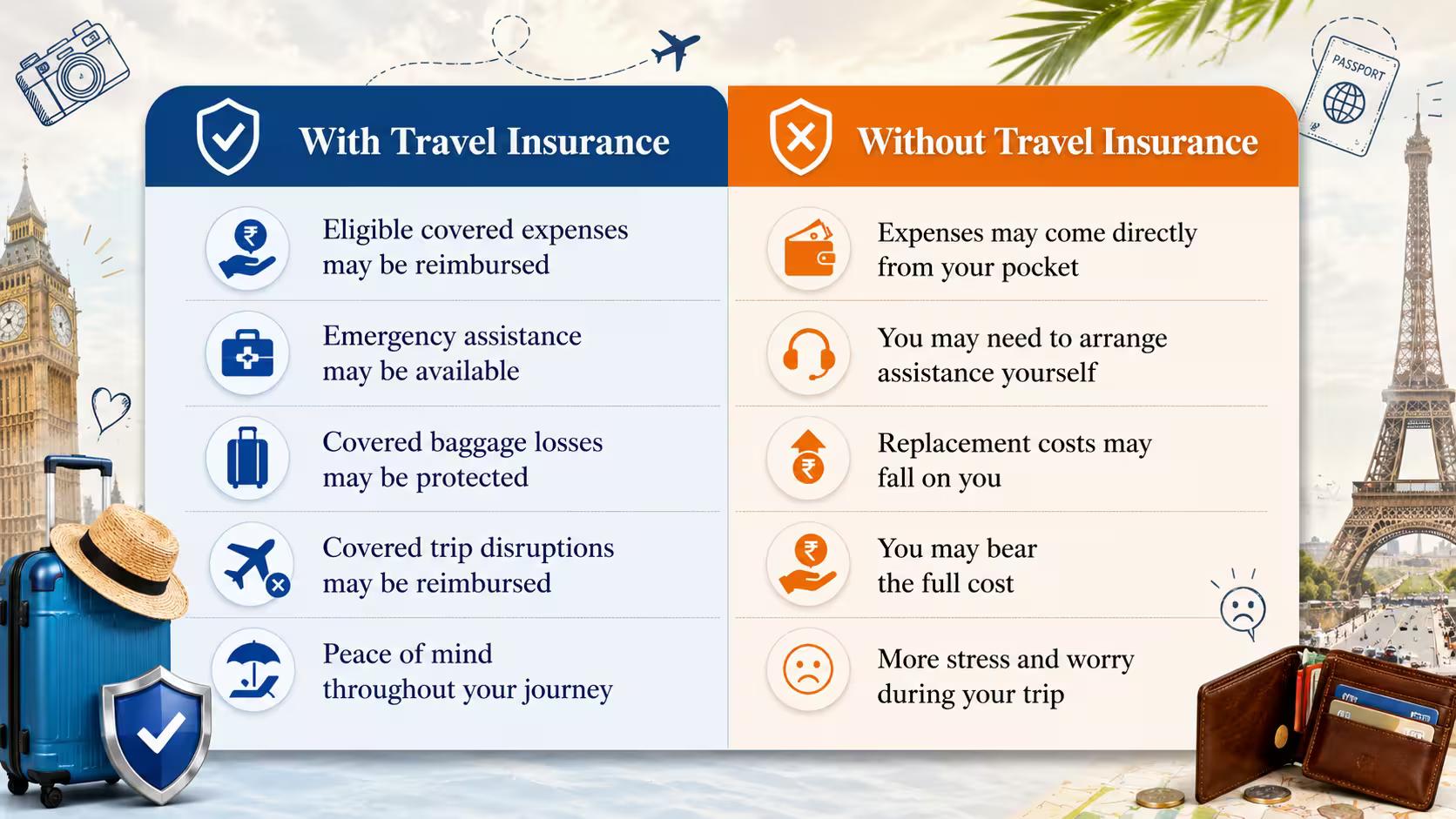
Travel Insurance vs. No Travel Insurance