Places to Visit in Germany
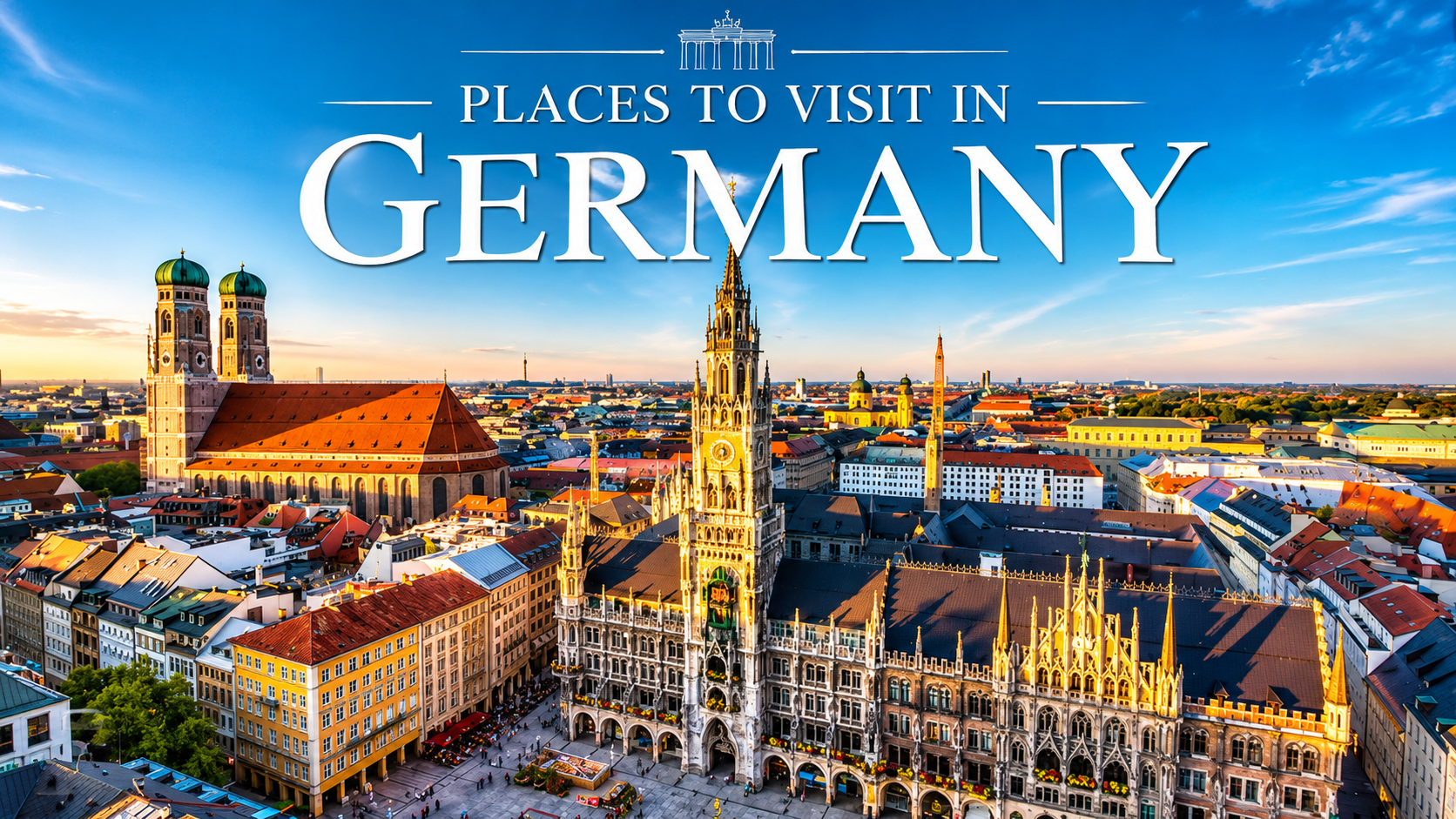
With its fairy-tale medieval castles, vibrant modern metropolises, scenic alpine passes, and rich cultural heritage, Germany stands as one of Europe's most rewarding travel destinations. Whether you are wandering through historic squares in Bavaria, cruising along the castle-studded Rhine River, or exploring world-class museums in Berlin, knowing the top places to visit in Germany allows you to design a balanced, unforgettable vacation.
For travelers planning their holiday from India, coordinating intercity trains, booking curated accommodations, and navigating Schengen visa documentation is made effortless with Vini Grow Holidays. Explore our customized Europe holiday packages or get expert guidance on your Germany Schengen visa application assistance before you depart.
Here is your detailed travel guide to the best places to visit in Germany, top activities, travel logistics, and visitor essentials.
1. Berlin: The Dynamic Capital of History, Art & Modern Culture
As Germany's capital and largest metropolis, Berlin represents an extraordinary fusion of turbulent 20th-century history and cutting-edge creative energy. It is an essential first stop for culture enthusiasts, architecture buffs, and urban explorers.
The Brandenburg Gate (Brandenburger Tor) & Pariser Platz
Commissioned by King Frederick William II in the late 18th century as a key city gate, this neoclassical sandstone monument stands as a global symbol of European unity and peace. Adorned with the iconic copper Quadriga sculpture (the goddess of victory driving a four-horse chariot), the gate sits at the head of the grand Unter den Linden boulevard. Visiting during twilight, when the columns are illuminated in warm golden floodlights, offers one of the most memorable photographic backdrops in the city.
The Berlin Wall Memorial & East Side Gallery
To understand modern Berlin, you must experience its Cold War division. The East Side Gallery is a preserved 1.3-kilometer stretch of the original Berlin Wall running along the Spree River, recognized as the longest open-air mural gallery in the world. It features over a hundred evocative artworks created by international artists immediately following the wall's fall in 1989, including the famous fraternal kiss between Leonid Brezhnev and Erich Honecker. A short ride away, the Berlin Wall Memorial (Gedenkstätte Berliner Mauer) on Bernauer Strasse preserves an actual strip of the "death strip," complete with a watchtower and border fortifications.
Museum Island (Museumsinsel)
Situated in the heart of the Spree River, Museum Island is a UNESCO World Heritage complex housing five internationally acclaimed institutions:
- The Pergamon Museum: Celebrated for colossal architectural reconstructions, including the Roman Market Gate of Miletus and the Ishtar Gate of Babylon.
- The Neues Museum: Home to ancient Egyptian antiquities, most notably the exquisite, 3,300-year-old limestone bust of Queen Nefertiti.
- The Alte Nationalgalerie & Bode Museum: Showcasing European neoclassical, romantic, and Byzantine sculptures.
The Reichstag Building & Glass Cupola
The seat of the German Federal Parliament (Bundestag) combines historic 19th-century stone masonry with an ultra-modern transparent glass dome designed by British architect Norman Foster. Visitors can walk up the interior spiraling ramps of the dome to look directly down onto the parliamentary chamber below—symbolizing governmental transparency—while taking in panoramic 360-degree vistas across the Tiergarten park and the Spree riverfront.
2. Munich & The Bavarian Alps: Traditions, Regal Palaces & Mountain Vistas
Munich, the capital of Bavaria, blends centuries-old regal architecture with bustling outdoor beer gardens, festive folk traditions, and immediate proximity to the snow-capped Alps. It serves as the southern gateway for fairy-tale day trips and alpine excursions.
Marienplatz & The Glockenspiel
Marienplatz has served as Munich’s central town square since 1158. The square is dominated by the ornate neo-Gothic facade of the New Town Hall (Neues Rathaus). Every day at 11:00 AM and 12:00 PM (and 5:00 PM during summer), thousands gather below the central clock tower to watch the mechanical Glockenspiel come alive. Featuring 43 bells and 32 life-sized figures, the display reenacts the 1568 royal wedding of Duke Wilhelm V and the traditional barrel-makers' dance (Schäfflertanz).
Neuschwanstein Castle (Füssen)
Located approximately two hours southwest of Munich in the foothills of the Allgäu Alps,Neuschwanstein Castle is arguably the most recognizable fortress on earth. Built under the eccentric King Ludwig II of Bavaria as a personal romantic refuge, its soaring white limestone turrets, dramatic cliffside perch, and forested mountain backdrop served as the real-world inspiration for Walt Disney's Cinderella castle.
- Traveler Pro-Tip: Walk across Marienbrücke (Mary’s Bridge), a footbridge suspended 90 meters above the Pöllat Gorge, for the classic, uninterrupted postcard vantage point of the castle exterior.
The English Garden (Englischer Garten) & River Surfing
Spanning 910 acres, the English Garden is one of the largest public urban parks in the world—surpassing London’s Hyde Park and New York’s Central Park. While its shaded meadows, lakefront beer gardens, and Monopteros temple are popular for relaxing strolls, its most famous curiosity is the Eisbachwelle. At this rushing section of the artificial Eisbach canal, year-round surfers ride a continuous standing wave right in the center of the city, regardless of whether it is midsummer or freezing winter.
Nymphenburg Palace & BMW Welt
Explore the expansive summer residence of the Wittelsbach monarchs, surrounded by formal French baroque gardens, tranquil canals, and carriage museums. Afterward, shift from imperial history to modern engineering at BMW Welt and Museum, located adjacent to the 1972 Olympic Park, showcasing futuristic automotive design and interactive exhibitions.
(Insert In-Article Image Here: munich-marienplatz-bavaria-germany-travel.webp — Historic Marienplatz square and Neues Rathaus in Munich Bavaria Germany tourist attractions)
3. Cologne & The Romantic Rhine Valley: Gothic Majesty & River Cruising
Situated along the banks of the Rhine River in western Germany, Cologne (Köln) is world-famous for its dramatic architecture, vibrant carnival spirit, and scenic river access.
Cologne Cathedral (Kölner Dom)
Dominating the city skyline, this colossal twin-spired Gothic cathedral is one of the largest and most famous Christian basilicas in the world. Taking more than 630 years to reach completion (from 1248 to 1880), the cathedral survived 14 direct aerial bomb hits during World War II while surrounding city blocks were leveled.
- Key Highlights: The gilded Shrine of the Three Holy Kings, considered the largest medieval reliquary in Europe, and the south tower climb of 533 stone steps delivering sweeping vistas of the Rhine and the city below.
Hohenzollern Bridge (Love Lock Bridge)
Directly adjacent to the cathedral, this three-arched iron railway and pedestrian bridge crosses the Rhine. Over the past two decades, couples from around the globe have attached hundreds of thousands of engraved padlocks to the bridge’s wire mesh fencing, throwing the keys into the waters below as a symbol of eternal devotion.
Upper Middle Rhine Valley Day Cruises
From nearby Koblenz, Mainz, or Rüdesheim, travelers can board day steamers to cruise through the Upper Middle Rhine Valley, a 65-kilometer UNESCO World Heritage stretch. The gorge is lined with terraced Riesling vineyards, medieval toll castles, half-timbered riverfront hamlets, and the fabled Lorelei Rock, where river legends tell of sirens luring boats onto dangerous shoals.
4. The Black Forest (Schwarzwald): Dense Canopies, Waterfalls & Cuckoo Clocks
Located in southwestern Germany in the state of Baden-Württemberg, the Black Forest gets its name from its dense canopy of evergreen firs that block sunlight from reaching the forest floor. It is the premier destination in Germany for hiking, alpine lakes, and traditional handicrafts.
Triberg Waterfalls & Cuckoo Clock Workshops
The mountain resort town of Triberg is famous for Germany's highest accessible waterfalls, cascading 163 meters down through granite ravines across seven distinct levels. Triberg is also the heartland of traditional Black Forest woodworking; visit the House of 1,000 Clocks to observe master artisans assembling mechanical, weight-driven cuckoo clocks carved from regional linden wood.
Lake Titisee & Baden-Baden
- Lake Titisee: A pristine glacial lake surrounded by rolling mountain peaks, ideal for electric boating, paddleboarding, and shoreline strolls along the Seestrasse promenade.
- Baden-Baden: A historic spa town renowned for its thermal mineral waters dating back to the Roman Empire. Unwind in the marble colonnades of the 19th-century Friedrichsbad Roman-Irish bathhouse or explore the gilded Belle Époque halls of the Baden-Baden Casino.
- Culinary Essential: Do not miss tasting an authentic slice of regional Schwarzwälder Kirschtorte (Black Forest Gateau), made with layers of dark chocolate sponge, fresh cream, sour cherries, and Kirschwasser (clear cherry schnapps distilled in the region).
5. Hamburg: Maritime Grandeur, Canal Bridges & Cutting-Edge Architecture
As Germany’s second-largest city and its primary maritime gateway, Hamburg boasts an open-minded, international atmosphere woven with more canals and bridges than Venice and Amsterdam combined.
Speicherstadt Warehouse District
Built between 1883 and 1927 on thousands of oak foundation piles, the Speicherstadt is the largest unified warehouse complex in the world. Its red-brick neo-Gothic facades, pointed turrets, and arched bridges crossing tidal canals create an atmospheric backdrop, particularly during twilight when water reflections highlight the historic architecture.
Elbphilharmonie Concert Hall
Rising dramatically atop an old brick cocoa warehouse in the HafenCity district, the Elbphilharmonie features a striking glass superstructure resembling a wave or hoisted sail. Visitors can ascend via a curved 82-meter escalator to the panoramic public plaza for unobstructed 360-degree views of Hamburg Harbor, maritime shipyards, and urban river channels.
Miniatur Wunderland
Consistently ranked on TripAdvisor as one of the most visited and highly rated indoor attractions in Europe, Miniatur Wunderland is the world's largest model railway system. Spanning multiple exhibition halls, it features over 1,100 digitally controlled trains, 290,000 miniature human figurines, and meticulous scale models depicting Hamburg, the Austrian Alps, Venice, Scandinavia, and a fully operational miniature airport with taking-off and landing scale aircraft.
6. Frankfurt am Main & Heidelberg: Modern Skylines to Ancient Universities
Frankfurt: The Manhattan of Europe
While Frankfurt is renowned primarily as continental Europe’s financial engine and home to the European Central Bank, it holds surprising cultural charm:
- Römerberg Square: The historic heart of Frankfurt, showcasing faithfully reconstructed 15th-century timber-framed merchants' houses, the Gothic Old Town Hall (Römer), and the nearby Imperial Cathedral of St. Bartholomew.
- Main Tower: Head up to the open-air observation platform on the 56th floor of this glass skyscraper for panoramic views of Frankfurt’s modern high-rise skyline and the winding Main River.
Heidelberg: Germany’s Oldest University Town
Located just one hour south of Frankfurt, Heidelberg is the archetype of German Romanticism.
- Heidelberg Castle (Schloss Heidelberg): Perched 80 meters above the Neckar River on the slopes of Mount Königstuhl, these sprawling red-sandstone Renaissance ruins house the Heidelberg Tun—the largest wine barrel in the world, capable of holding over 219,000 liters.
- The Philosopher’s Walk (Philosophenweg): A scenic uphill path on the opposite bank offering classic vistas across the Old Bridge (Alte Brücke) and the terracotta roofs of the historic center.
Curated 7-Day Classic Germany Itinerary
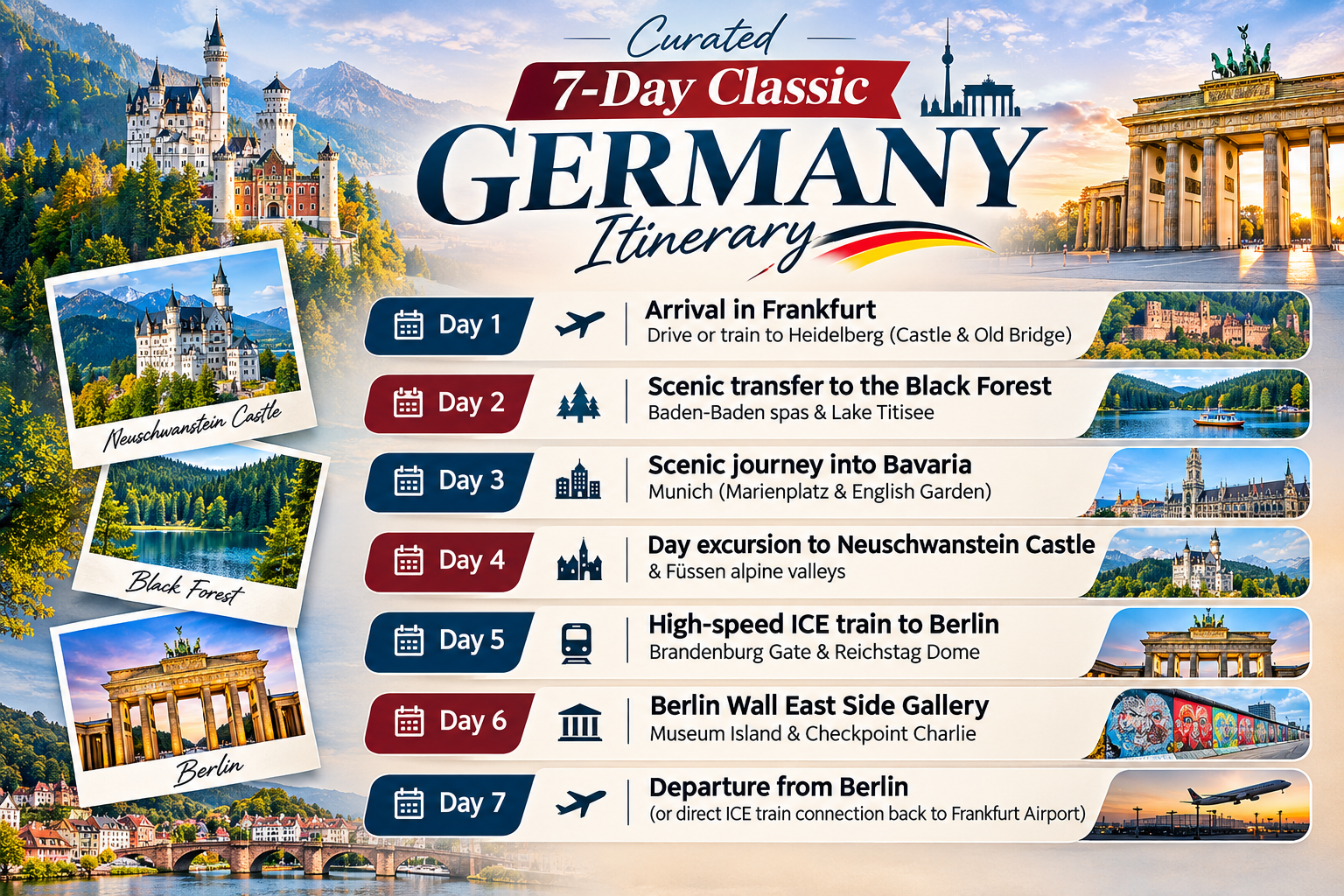
Planning a multi-country European journey? Many travelers prefer combining Germany with Switzerland, France, Austria, and Italy. Explore our complete 9-day Glimpses of Europe Tour or the comprehensive 15-day Grand Tour of Europe package for synchronized multi-country transit.
Essential Travel Logistics & Visa Guidelines for Indian Passport Holders
Germany Schengen Visa (Category C Short-Stay Tourist Visa)
Germany is part of the 29-nation European Schengen Area. Indian passport holders visiting for tourism, family visits, or business must secure a Category C Schengen visa prior to departure.
- Application Channel in North India: Visa applications are managed administratively through VFS Global in New Delhi (located at the Shivaji Stadium Metro Station Concourse, Baba Kharak Singh Marg, Connaught Place) and evaluated by the Embassy of the Federal Republic of Germany.
- Mandatory Checklist Requirements:
Passport with at least 6 months remaining validity from your scheduled departure date and two blank pages.
Fully verified, confirmed flight tickets matching your itinerary dates.
Confirmed hotel reservations across all destinations covering every night in the Schengen territory.
Financial proof: Last 3–6 months bank statements stamped by your bank demonstrating adequate subsistence funds, alongside personal Income Tax Returns (ITR-V) for the last 2 assessment years.
A detailed day-by-day travel plan explaining your intended route and sightseeing activities.
Mandatory Insurance: Evidence of an approved mandatory €30,000 Schengen travel insurance policy covering emergency medical repatriation and hospitalization expenses valid across all Schengen states.
- For complete step-by-step documentation rules, review our comprehensive Schengen visa guide for Indians.
Best Time to Visit Germany
- May to September (Spring & Summer): Long daylight hours, vibrant open-air beer gardens, and comfortable temperatures averaging 18°C to 26°C.
- Late September to October: Autumn foliage across Bavarian alpine valleys, coinciding with the world-famous Oktoberfest in Munich.
- Late November to December: Cold temperatures accompanied by Germany's traditional Christmas Markets (Weihnachtsmärkte), featuring warm Glühwein (mulled wine), gingerbread, and festive crafts in Nuremberg, Dresden, and Cologne.
Getting Around: Deutsche Bahn High-Speed Rail
Germany’s railway system is among the most comprehensive in the world.Deutsche Bahn (DB) operates Intercity Express (ICE) trains connecting major hubs like Frankfurt, Berlin, Munich, and Cologne at speeds up to 300 km/h. For seamless travel, consider the German Rail Pass, which offers flexible travel days on all regional and high-speed DB trains. Within cities, integrated transit networks of U-Bahn (underground metro), S-Bahn (suburban commuter rail), and trams provide reliable access to every major neighborhood.
Frequently Asked Questions (FAQs)
What are the top 5 places to visit in Germany for first-time travelers?
The top five destinations for first-timers are Berlin (historic landmarks and Museum Island), Munich (Bavarian culture and gateway to the Alps), Neuschwanstein Castle (the iconic fairy-tale castle), Cologne (the Gothic cathedral and Rhine River), and the Black Forest (nature, waterfalls, and traditional villages).
How many days are ideal for a complete trip to Germany?
An itinerary of 7 to 10 days is ideal for covering Germany's core highlights. This allows you 2–3 days to explore Berlin, 3–4 days in Munich with a day trip to Neuschwanstein Castle, and 2 days to experience either Cologne or the Black Forest.
What is the official currency in Germany, and can I use international cards?
The official currency is the Euro (€ / EUR). Major credit and debit cards (Visa and Mastercard) are widely accepted at hotels, modern restaurants, department stores, and train ticket kiosks. However, carrying cash is recommended for small family bakeries, kiosks (Imbiss), local taxis, public restrooms, and traditional beer gardens.
Plan Your German Vacation with Vini Grow Holidays
Navigating overseas train timetables, hotel selections, regional alpine transfers, and Schengen visa paperwork doesn't have to be overwhelming. At Vini Grow Holidays, our dedicated Europe travel consultants in West Delhi provide end-to-end management for your holiday:
- Customized day-wise itineraries tailored around your specific preferences, travel pace, and budget.
- Seamless booking on direct flights from Delhi to Frankfurt or Munich.
- Handpicked 4-star and 5-star hotel stays with daily breakfast and private station/airport transfers.
- Comprehensive document verification and appointments for your Germany Schengen visa application assistance.
Ready to experience the castles, culture, and alpine landscapes of Germany? Connect with the Vini Grow Holidays travel specialists in Janakpuri or reach out to our team today!
- Office Address: Office 114B, First Floor, Jaina Tower-2, District Centre, Janakpuri, New Delhi – 110058
- Call / WhatsApp: +91 9220270444
- Email: info@vinigrowholidays.com
- Website: https://vinigrowholidays.com