How to Apply for Dubai Tourist Visa from India Online
Dubai Tourist Visa Application Process for Indians: Types, Documents, Fees & Step-by-Step Guide
This article is part of our complete International Tourist Visa Guide for Indians. If you're not sure whether Dubai needs a visa at all for your situation, start there.
Yes - Indian passport holders need a visa arranged in advance to enter Dubai and the wider UAE for tourism, except for a narrow group who already hold a valid US Green Card or a UK/EU residence visa, who may qualify for a pre-approved 14-day visa on arrival. Almost every other Indian tourist applies for a 30-day or 60-day tourist visa, submitted online through an airline, hotel, tour operator or licensed UAE visa agent - not directly to a government portal by yourself. A newer option, the self-sponsored 5-year multiple-entry tourist visa, suits frequent visitors who can show a stable financial profile. This guide walks through all three routes, the actual documents required, current fee ranges, and the step-by-step process.
Do Indians Need a Visa for Dubai?
Yes, in almost all cases. Dubai and the rest of the UAE are not visa-free or visa-on-arrival destinations for the great majority of Indian passport holders. A pre-approved visa is required before you fly, and airlines will not let you board without one.
The one exception is a specific group of Indian travellers who already hold a valid US Green Card, or a UK or EU residence visa - they may be eligible for a visa-on-arrival facility, covered separately below. Everyone else needs to arrange a visa in advance.
This is a genuinely different structure from destinations like Vietnam or Indonesia, where an individual traveller applies directly on a government eVisa portal. Dubai's tourist visa system is built around sponsors - an airline, a hotel, a tour operator, or a UAE-based individual or company - submitting the application to or ICP on the traveller's behalf. Most Indian travellers never interact with a government portal directly; they go through a licensed travel agent or the airline they're flying with.
Types of Dubai Tourist Visas for Indians
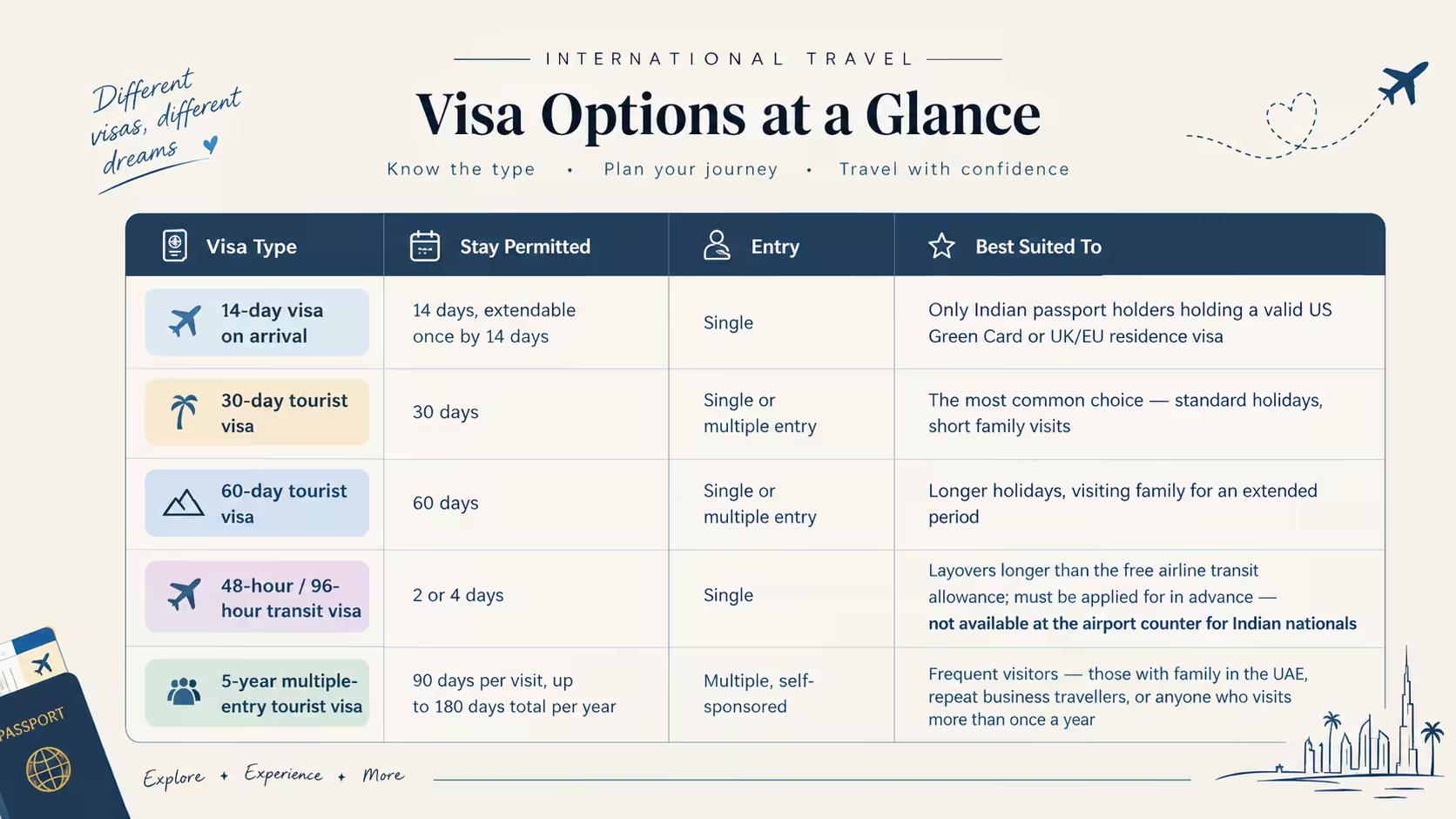
A note on the transit visa: several older blog articles suggest Indian travellers can get a transit stamp at the airport if their layover runs long. As of current UAE practice, both the 48-hour and 96-hour transit visas must be applied for and approved before travel - treat a long layover the same way you'd treat a short tourist trip, and apply at least a few days ahead.
Who Can Actually Apply, and Through Whom
This is the step almost every other guide skips, and it's the first thing you should understand before choosing a visa type.
Individual Indian travellers generally cannot log into GDRFA or ICP's systems and submit a tourist visa application entirely on their own, the way you might for a Vietnam eVisa. The standard tourist visa route requires a sponsor who takes responsibility for the application:
- The airline you're flying with - Emirates, flydubai and other carriers commonly process visas for passengers booking flights and hotels through them
- Your hotel - many UAE hotels offer visa processing as part of a booking package
- A licensed UAE tour operator or travel agency - the most common route for independent travellers
- A UAE resident or company inviting you, for family or business visits
- Yourself, directly, only for the self-sponsored 5-year multiple-entry visa, or if you personally hold an ICP/GDRFA account eligible to apply (relevant mainly to UAE residents applying for visiting relatives, not for most tourists applying for themselves)
What this means practically: when you "apply online" for a standard Dubai tourist visa, you are almost always applying through a travel agent's, airline's or hotel's platform, which then submits the request to GDRFA or ICP under their sponsorship. This is normal and not a scam in itself - but it does mean the agent or platform you choose matters, since they are handling your documents and acting as your sponsor.
How to protect yourself: use only licensed, verifiable travel agencies or your actual airline/hotel booking platform. Avoid any site that cannot clearly explain who is sponsoring your visa. If in doubt, ask the agent directly which entity (airline, hotel, or their own company licence) is submitting your application.
Documents Required for a Dubai Tourist Visa
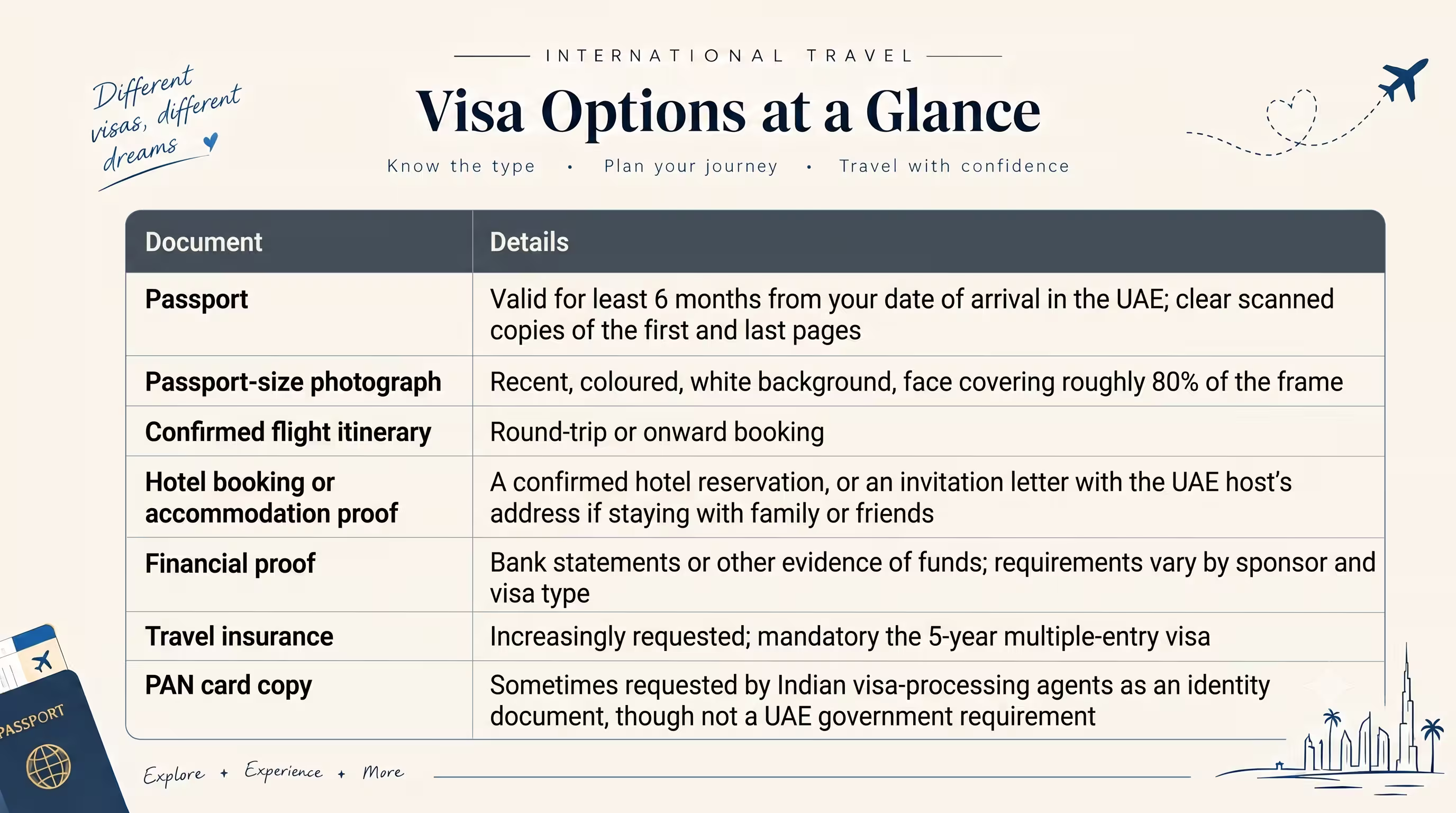
For the 5-year multiple-entry visa specifically, the documentation is more detailed:
- Bank statements for the last six months showing a balance of at least US$4,000 or its equivalent
- Valid UAE health insurance
- A confirmed round-trip ticket
- Proof of accommodation - hotel booking or a residential address
- A passport-size photograph and passport copy
A caution on family-invitation and financial-record routes: some Indian applicants who don't have prior travel history to the US, UK, Schengen area or similar destinations may be asked for additional financial evidence - proof of annual income or fixed deposits - as an alternative eligibility route. Requirements here vary by sponsor and are not uniformly published, so confirm the exact ask with your specific agent or airline rather than assuming a fixed figure applies to you.
Step-by-Step Dubai Visa Application Process
Step 1: Choose the Right Visa Type
Decide based on your trip length and how often you plan to visit - see the decision guide near the end of this article. Most first-time tourists choose the standard 30-day single-entry tourist visa.
Step 2: Choose Your Sponsor / Application Channel
Decide whether you'll apply through your airline, your hotel, a licensed travel agency, or - if eligible - the self-sponsored 5-year route. This decision affects both your cost and your documentation requirements.
Step 3: Gather Your Documents
Passport, photograph, flight itinerary, accommodation proof and financial documents as listed above. Make sure your passport has at least six months' validity and your photograph meets the specification - mismatched or non-compliant photographs are one of the most common causes of delay.
Step 4: Submit the Application
Provide your documents to your chosen sponsor's online platform. Fill in your personal details exactly as they appear on your passport - spelling errors or mismatches are a frequent, avoidable cause of rejection or delay.
Step 5: Pay the Visa Fee
Pay through the sponsor's platform. Understand what the quoted price includes - the UAE government fee, VAT, mandatory insurance (where applicable) and the sponsor's own service charge are often bundled into one number, and it's worth asking for a breakdown.
Step 6: Wait for Processing
Standard processing typically takes 3 to 5 working days, though express or "urgent" services offered by some agents can shorten this to 24–48 hours for an additional fee. The 5-year multiple-entry visa is generally processed in 2 to 5 working days once submitted.
Step 7: Receive Your e-Visa
Your approved visa arrives by email as a PDF. There is no physical stamp to collect in India - print a copy and carry it with your passport, and also keep a digital copy accessible on your phone.
Step 8: Verify the Details
Before you travel, check your name, passport number, visa validity dates, permitted stay and entry type (single or multiple) on the e-visa exactly as they appear on your passport. Errors are far easier to fix in India than at Dubai airport.
Step 9: Travel and Note Your Entry Date
Your permitted stay is counted from the date you first enter the UAE, not from the date the visa was issued. If your visa was issued on the 1st but you fly in on the 10th, your clock starts on the 10th. Keep this date noted so you know exactly when your visa expires.
Dubai Tourist Visa Fees for Indians
The government charge and the total price you pay through an agent are two different numbers, and understanding the difference helps you evaluate whether a quote is reasonable.
UAE government (GDRFA) base fee, before agent service charges, VAT or insurance:
*INR figures are indicative only, based on exchange rates in mid-September 2026, and exclude VAT, service charges, mandatory insurance and any bank/card conversion fee. Exchange rates and fees change - confirm the current figure at the time of application.
What you'll typically pay in total through an airline, hotel or travel agent runs noticeably higher than the bare government fee once VAT, insurance and the sponsor's service charge are added - commonly in the range of ₹7,000–₹13,000 for a standard 30-day single-entry visa, and ₹13,000–₹18,000+ for a 60-day or multiple-entry visa, with express processing adding a further premium. These figures vary significantly by provider, so always ask for an itemised breakdown - government fee, insurance, VAT and service charge - rather than accepting a single bundled number.
Do not assume the cheapest quote is the best one. A visa processed cheaply by an unlicensed or unclear sponsor carries more risk than a slightly more expensive one processed by your airline or a verifiable, licensed agency.
Dubai Visa on Arrival - Who Actually Qualifies
This is the section where most competing content gets the details wrong, so it's worth being precise.
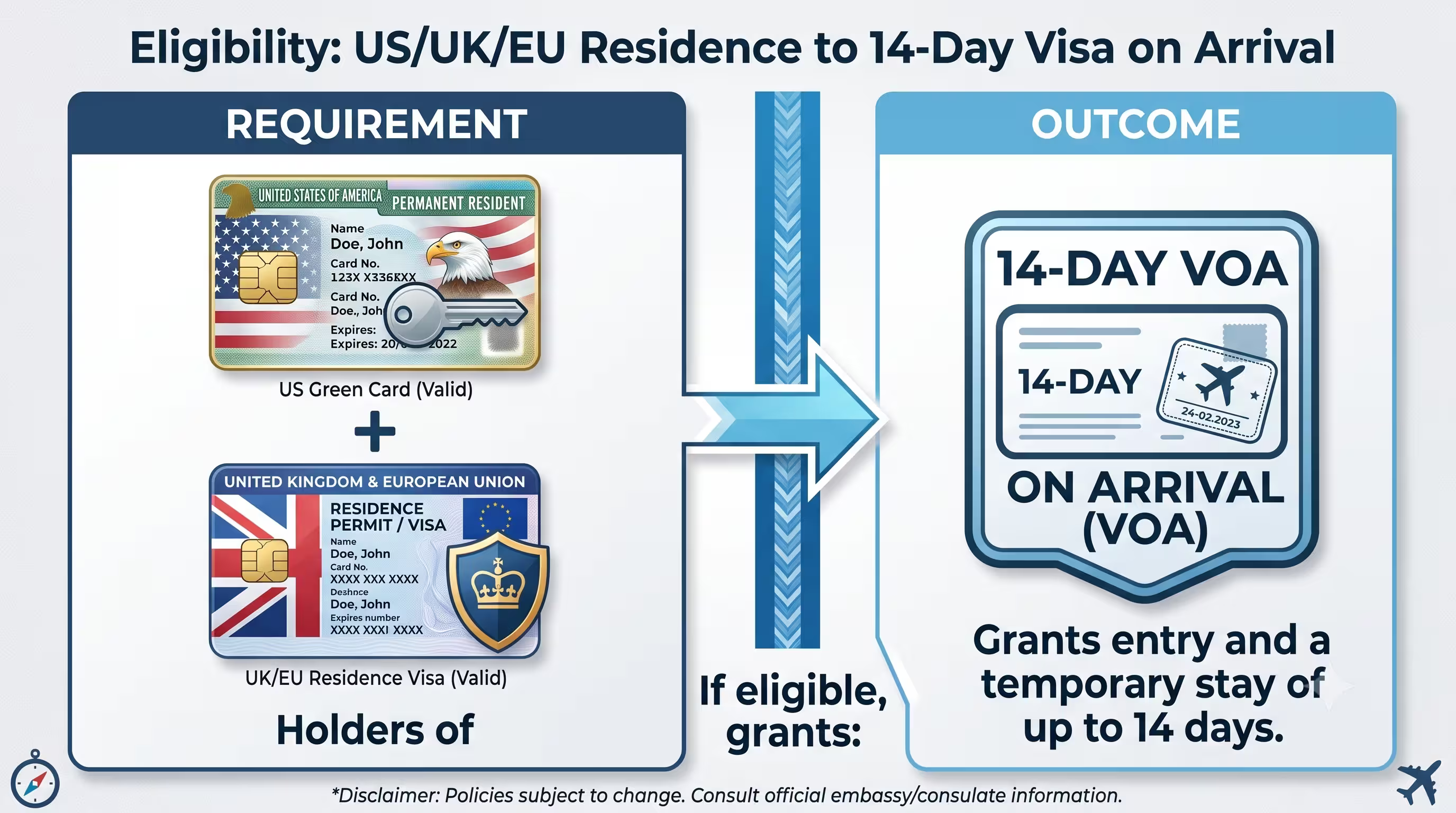
You may be eligible for a 14-day visa-on-arrival facility only if you hold ONE of the following, valid for at least six months from your date of entry:
- A US Green Card (permanent resident card), or
- A valid UK residence visa, or
- A valid EU (Schengen) residence visa
This is narrower than "any valid US, UK or Schengen visa," a phrasing you'll see on many travel sites. A US tourist visa (B1/B2) or a UK/Schengen short-stay visa does not, by itself, qualify you - the requirement is specifically a Green Card for the US, or a residence visa for the UK/EU, not a visit visa.
Since 2024, this is also not a true walk-up counter facility. Eligible Indian travellers must apply online in advance - through GDRFA's or ICP's own platform, or through an authorised typing centre such as Amer - before travelling, rather than requesting the visa after landing. Once approved, the entry permit is issued and stamped at the airport on arrival.
- Stay permitted: 14 days, extendable once for a further 14 days
- Fee: approximately AED 100 for the initial permit and AED 250 for the extension, plus a small service charge - confirm the current figure with GDRFA or ICP before applying
- Where to apply: through the GDRFA Dubai smart services portal, the federal ICP portal, or an authorised typing/Amer centre
If you don't hold a qualifying Green Card or residence visa, this route simply isn't available to you - apply for a standard 30-day or 60-day tourist visa instead.
The 5-Year Multiple-Entry Tourist Visa
Introduced as part of the UAE's broader visa reforms, this is a genuinely useful option for Indian travellers who visit the UAE more than once a year - to see family, for recurring business trips, or simply because they holiday there often.
Key features:
- Valid for 5 years from the date of issue
- Allows multiple entries and exits during that period
- Each stay is capped at 90 days, extendable once for a further 90 days, provided total stay in a year does not exceed 180 days
- Self-sponsored - you do not need a UAE-based sponsor, employer or host to apply
- Open to applicants of any nationality who meet the financial and documentation criteria
Eligibility requirements:
- Bank statements for the last six months showing a balance of at least US$4,000 or its equivalent in foreign currency
- Valid UAE health insurance
- A round-trip ticket
- Proof of accommodation - hotel booking or a UAE address
- Passport valid for at least six months from the date of entry
How to apply: through the GDRFA Dubai website or mobile app, the federal ICP portal, or in person at an authorised Amer typing centre. Processing typically takes 2 to 5 working days.
Who this suits best: Indian travellers with family based in the UAE who visit repeatedly through the year, frequent business travellers, and anyone who has found themselves reapplying for a fresh 30-day visa multiple times in the same year - the 5-year visa removes that repetition entirely.
Processing Time and Visa Validity vs Permitted Stay
Processing time for a standard tourist visa typically runs 3 to 5 working days, though it can extend during peak seasons (winter holidays, Eid, and periods around major Dubai events and expos) or if documents are incomplete. Express services exist through most agents for an additional fee, often reducing this to 24–48 hours.
Two terms that are easy to confuse:
- Visa validity - the window during which you must enter the UAE after your visa is issued
- Permitted stay - how long you may remain per visit, counted from your actual date of entry, not your visa issue date
A 30-day tourist visa issued on 1 October but used to enter on 10 October gives you until roughly 9 November to leave - not until 31 October. Track your actual entry date carefully; this is the single most common source of accidental overstay.
Extending a Dubai Tourist Visa
If you decide you want to stay longer than your current visa allows, extension is possible without leaving the UAE - this changed as of December 2025, when in-country extensions stopped requiring travellers to exit and re-enter the country (the previous "visa run" practice).
- Extensions can be arranged through a licensed agent or an Amer typing centre while you are still in the UAE
- Apply before your current visa expires - extensions submitted after expiry are treated as an overstay situation
- Overstaying carries a daily fine, and enforcement has become stricter in recent years - know your exit date and plan around it
Common Mistakes That Delay or Reject Dubai Visa Applications
Assuming you can apply directly to a government portal without a sponsor, then being confused when a travel agent's platform is the actual application channel.
Misreading the visa-on-arrival eligibility - arriving with a US tourist visa instead of a Green Card, or a UK visit visa instead of a residence visa, and being turned away.
Passport photograph non-compliance - wrong background, spectacles worn, insufficient face coverage.
Name or detail mismatches between the application and the passport.
Insufficient passport validity - less than six months remaining at the date of entry.
Booking non-refundable flights before visa approval. Wait for confirmation, or use a flexible fare.
Confusing visa validity with permitted stay, leading to accidental overstay and fines.
Using an unverified or unlicensed "visa agent" found through a social media ad, and having no clear answer about who the actual sponsor is.
Applying for a 48/96-hour transit visa at the airport counter, expecting it to be issued on the spot - it must be arranged in advance.
Which Visa Should You Choose? A Quick Decision Guide
- One short holiday, first time visiting Dubai → Standard 30-day single-entry tourist visa
- A longer trip, or visiting extended family for several weeks → 60-day tourist visa (single or multiple entry, depending on your itinerary)
- You hold a US Green Card, or a UK/EU residence visa → Check eligibility for the 14-day visa-on-arrival route; apply online in advance
- A long layover between two other flights → Apply in advance for a 48-hour or 96-hour transit visa; do not expect to get one at the counter
- You visit the UAE more than once a year, or have family based there → The self-sponsored 5-year multiple-entry visa is very likely your best long-term option