Thailand E-Visa and Visa Exemption Guide for Indians (2026)
This guide is part of our international tourist visa guide for Indians.
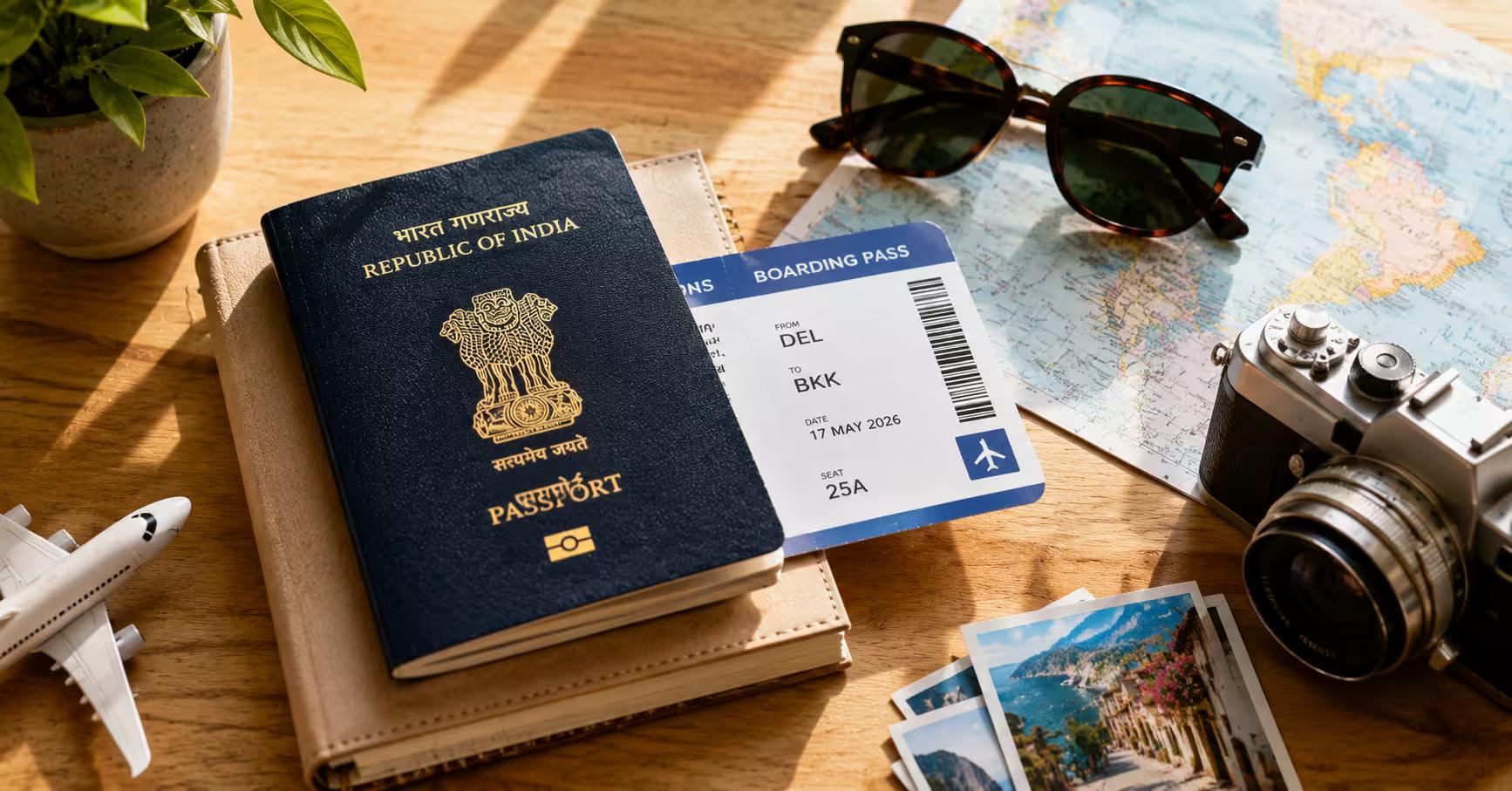
Indian ordinary passport holders do not need a visa for a tourist trip to Thailand of up to 30 days. The 30-day visa exemption for Indians took effect on 15 September 2026 and replaced the earlier 60-day exemption, according to the Royal Thai Embassy in New Delhi and TAT.
Two things still apply to every traveller:
- Complete the free Thailand Digital Arrival Card (TDAC) online within 3 days before you arrive.
- If you need more than 30 days, or the exemption does not fit your trip, apply for an e-Visa at thaievisa.go.th before you travel.
Do Indians Need a Visa for Thailand?
For tourism of up to 30 days, no. India is on the list of 60 countries and territories that TAT says qualify for the 30-day tourism exemption from 15 September 2026.
A few points that matter:
- The 60-day stay is gone for new arrivals. If you entered Thailand before 15 September under the old rules, you can stay until the end of the period stamped on your passport, as Business Standard reported from the embassy's announcement.
- This is a visa exemption, not visa on arrival. TAT lists visa on arrival for only three nationalities: Azerbaijan, Belarus and Serbia. Indians are not on that list.
- It is not an e-Visa. You do not apply for anything in advance, except the TDAC.
- Check your purpose of travel. TAT describes the exemption as a tourism scheme. The embassy's visa page says "tourism and short-term business engagements". If your trip involves business, confirm with the embassy before relying on it.
Exemption means you skip the visa application. It does not mean you skip entry checks.
Thailand Visa Exemption vs E-Visa
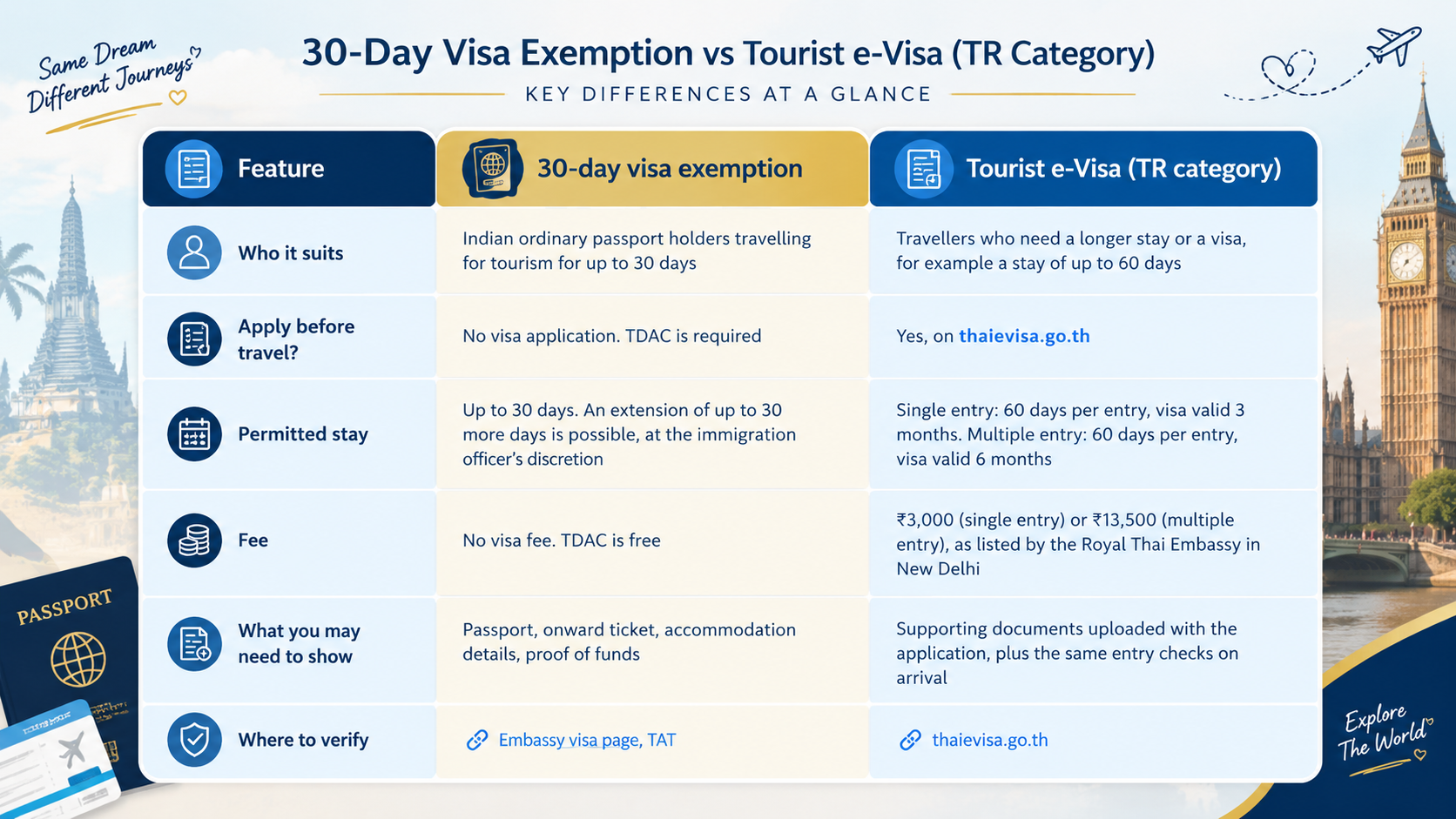
Fees on the embassy page are updated by the embassy and may change. Confirm the amount on the portal when you apply. Fees are not refundable once paid.
Thailand Entry Requirements for Indian Travellers
Some requirements are firm. Others are things an immigration officer may ask to see. Here is the difference.
What you must do
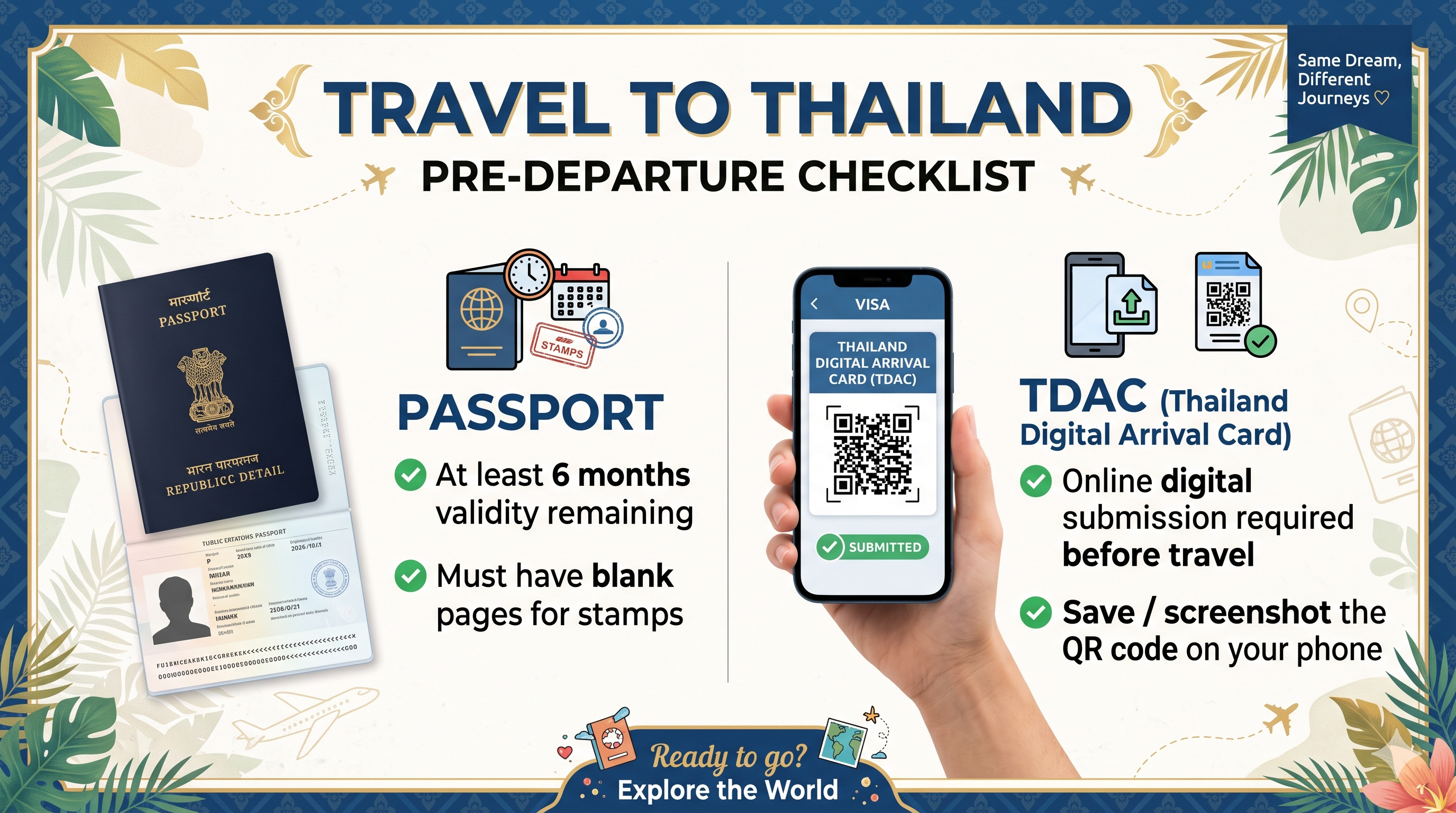
- Hold a valid passport. Officials commonly cite at least six months' validity, so check yours well before you book. Keep blank pages free for stamps.
- Submit the TDAC. The Thai embassy in Abuja's TDAC notice says all travellers must complete it, including those entering under the visa exemption, and that it must be submitted within 3 days before arrival and registered every time you enter. It is not a visa. It is free, and the only official site is tdac.immigration.go.th.
What officers may ask to see
TAT says entry also depends on valid travel documents, accommodation details and evidence of onward travel where required. In practice, keep these ready:
- A confirmed return or onward ticket
- Your first-night hotel booking or address
- Proof of funds, as explained below
- Your TDAC QR code, saved on your phone
Proof of funds: the "20,000 baht rule"
TAT's July 2026 reminder explains that the rule has existed since 1980. It lists these amounts:
- Visa-exempt entry and visa on arrival: 10,000 baht per person, or 20,000 baht per family
- Tourist visa (including an e-Visa): 20,000 baht per person, or 40,000 baht per family
- Children under 12 are exempt
Official pages are not fully consistent here. The Royal Thai Embassy in Washington quotes 20,000 baht per person for the tourist exemption. As general practical advice, not an official rule, be ready to show the higher figure in cash, foreign currency or payment documents. Officers apply this at their discretion.
How many times can you enter?
TAT says that for entry through land-border checkpoints, the 30-day exemption can generally be used no more than twice per calendar year. Its notice does not state a cap for arrivals by air. Even so, entry is always at the officer's discretion, so repeated back-to-back exemption stays can attract questions.
How to Apply for a Thailand E-Visa from India
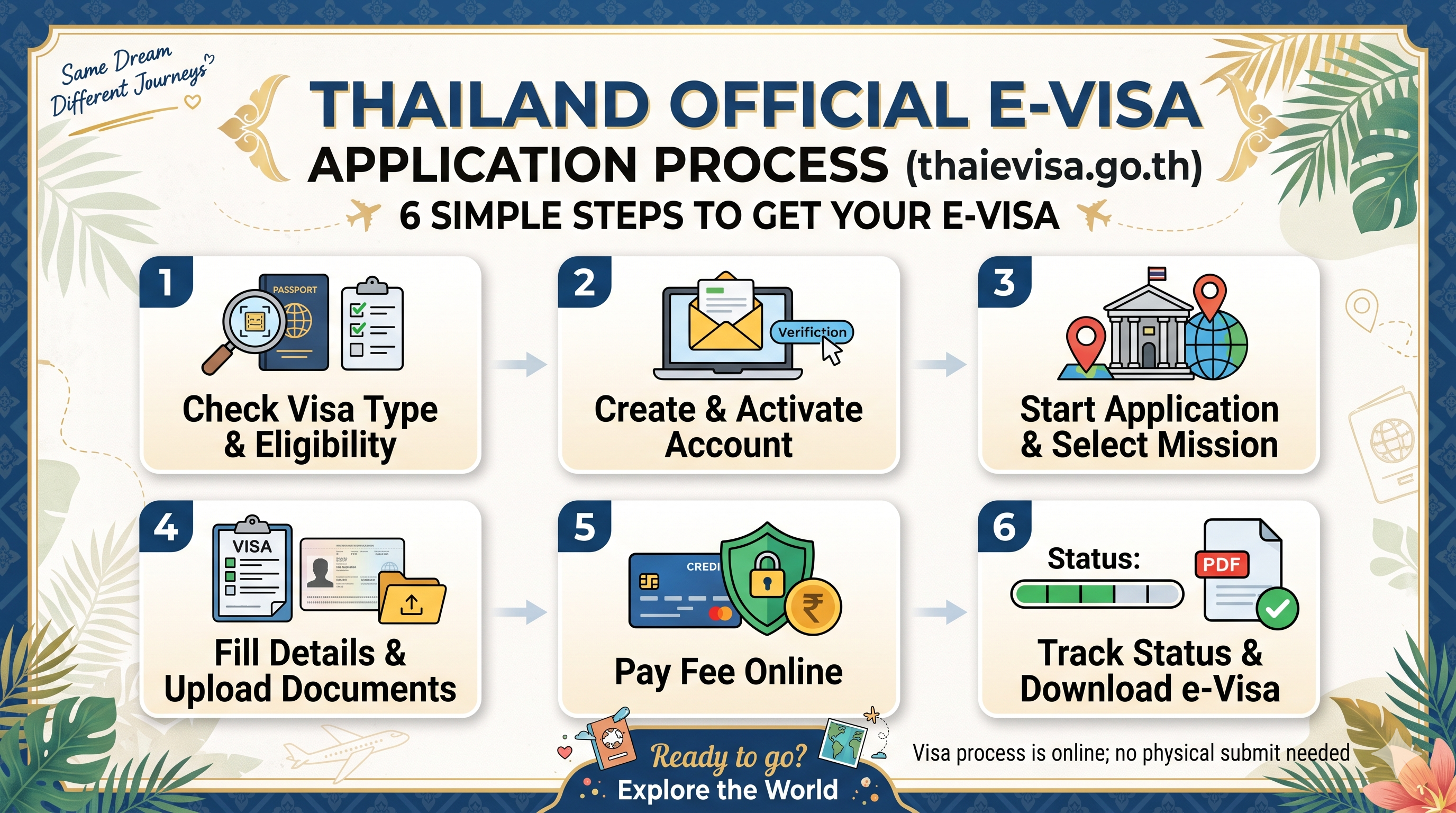
The Royal Thai Embassy in New Delhi says that since 1 January 2025, all applicants must apply through thaievisa.go.th. The steps below follow the portal's official application manual.
Check your visa type and eligibility. Use the portal's "Do I need a visa?" check and the embassy's visa page to confirm the category, number of entries and fee.
Create an account. Register with your details, then click the activation link sent to your email. If it does not arrive within 30 minutes, check your spam folder and use the "resend" option.
Start a new application. Enter your passport country, current location, the Thai mission you are applying to, visa type, purpose and number of entries.
Fill in your details and upload documents. Upload your passport bio page and photograph, then complete the personal, address, employment and accommodation sections. Add the supporting documents listed for your visa category.
Pay the fee on the portal. Check the details carefully. The manual notes that a successful payment is not refundable.
Track your application and download the e-Visa. If an officer asks for more documents, use the "Request Document" option on your dashboard. Once approved, download the confirmation and carry a copy with your passport.
Processing times, fees and document lists depend on the visa category and the Thai mission handling your application. Official pages we checked do not give a fixed processing period, so apply well before your travel date. Approval is decided by the Thai authorities and cannot be guaranteed.
Common Thailand Visa Mistakes to Avoid
- Planning for 60 days. For arrivals from 15 September 2026, the exemption is 30 days. Older pages, including some airline and agent pages, may still show 60.
- Treating exemption as "no checks". Funds, onward travel and accommodation details can still be asked for.
- Skipping the TDAC or paying a look-alike website. The official TDAC is free.
- Using unofficial e-Visa sites. The official portal is thaievisa.go.th. Check the address ends in .go.th.
- Relying on the exemption for business. Confirm with the embassy first.
- Overusing land-border entries. Plan around the twice-a-year limit.
- Booking non-refundable travel before checking eligibility or, if you need an e-Visa, before it is approved.
- Trusting outdated advice. Check the date on any source, including this one.
Pre-Departure Checklist
□ Passport valid for 6+ months, with blank pages □ Confirmed that 30 days covers your whole trip (or e-Visa approved) □ TDAC submitted within 3 days before arrival, QR code saved □ Return or onward ticket □ First-night accommodation details □ Proof of funds ready (cash, foreign currency or payment documents) □ Travel insurance, if you want medical cover during your trip □ Printed and digital copies of your documents
Not sure which route fits your plan? Our Thailand visa assistance page explains how we can help with documentation.